Showing posts with label Wildfires. Show all posts

April 20, 2014

Pasqueflower

Pasqueflower
Pulsatilla patens
Ranunculaceae (Buttercup Family)


Quick ID
Look for tufts of silky leaves growing from a perennial root crown, about 6" tall.  The leaves are divided into wispy leaflets, generally in threes.  The silver dollar sized flowers lack petals; what a "normal" person would call the petals are technically sepals, forming a cup-shaped calyx around a cluster of waggly yellow stamens.  (Calyx is what the sepals are called collectively.  If they were petals, it would be called a corolla.  Botany, boom.)
Flowers, which come up before the leaves, are shades of purple, from deep mauve to pale lavender.  They have silvery hairs on the outside, with smooth, lighter colored inner surfaces.  Although you might find a rare white P. patens, it's more likely what you're seeing is the western pasqueflower, P. occidentalis, or one of the Anemone species.

The flowers poke upright when they're new, then hang down like a bell as they mature, and finally give way to little smokebombs of tufted hairs as they set fruit.


Range
P. patens is found in the boreal zone (45°-65° latitude) all around the northern hemisphere.  It's fairly common in the the western region of North America, from Alaska down to New Mexico.  The pasqueflower prefers drier places than many of its Ranunculaceae cousins.  Look for it in grasslands or open rocky (often south-facing) slopes, in steppe to subalpine zones. (Side note.  Steppe communities are basically grassland prairies and plains, where the only trees found are the ones growing by water, and the subalpine region is found just below the treeline.  The elevation of these zones can vary dramatically based on where you are in the world.)


What's in a Name?
"Pasque" is from the original Latin word for Easter, Pascha.  You can usually find these flowers blooming around the Easter holiday...oftentimes before the snow is even off the ground.  The species name patens means "spreading," and is one you see a lot in the plant world.  Pulsatilla is derived from the Latin pulso, meaning battered or beaten.  This might be because the flowers, top-heavy on their delicate stems, bob around and seem battered by the wind.

This segues nicely into a quick chat about anemones.  Most (but not all) sources agree that anemones were named for the Greek anemos, "wind," hence the common name of windflower.  Maybe, as some say, it's because the flowers only open when they're beaten by the wind, or on the other hand, won't open if the wind is blowing.
Maybe the Greek wind gods, the Anemoi, use these flowers to herald their arrival in spring.  Or maybe (and this is the one I like to believe) they're windflowers because their seeds are so obviously and perfectly adapted for wind dispersal.  Their tiny nut-like achenes (a one-seeded fruit) sport feathery plumes that just beg to be blown and tumbled across an open prairie.  Pulsatilla patens shares pretty much all characteristics with those of Anemone, except the hairy tails of their fruits are long like a kite.  Indeed, pasqueflower is often cited as Anemone patens.  

Common names for this plant can be confusing.  It's sometimes called prairie smoke (in reference to the hairy fruits), although this is more widely accepted as the common name for Geum triflorum.  Many sources list it as prairie crocus, although the garden-variety crocus we all know and love is actually in the iris family.  It's also known as the Easter flower, May Day flower, cutleaf anemone, and probably a host of other regional names.  

Tidbits
As with all of the Ranunculaceae crew, the pasqueflower contains poisonous compounds that can make you really sick, causing nausea, dizziness and a drop in blood pressure.  And as with pretty much all poisonous plants, there are numerous accounts of people using it medicinally to treat an array of ailments.  Here's what Montana Plant Life has to say...
Use of pasqueflower reportedly lessens sexual excitement. It does not diminish sexual power but rather strengthens it by lessening excitement. A drug derived from the chopped whole plant induces vomiting and irritation of the kidneys. In high doses it acts as a depressant on the central nervous system and the heart. A decoction of the plant was used by the Blackfoot Indians to speed delivery of a child.
Yeesh.  As always, proceed with caution.  Plants are crazy dangerous.  Durr.
I did think it was interesting, however, to find so many references to using mashed pasqueflower leaves as a "counter-irritant" for bruises, sore muscles and rheumatic joints.  Is this like when you have a toothache and someone offers to stomp on your foot to distract you from the pain?  Must be!  I do know these leaves are covered in little hairs, and handling them too much can be really irritating to sensitive skin.
Being a common plains wildflower, the toxins in pasqueflower can be a problem for domestic grazing animals.  I've also read that dense stands of pasqueflower is an indication that the land has been overgrazed, but can't find any decent explanation as to why this is.  Are they pioneer species, the first to colonize the disrupted ecosystem, or are they just growing in abundance because grazers selectively avoid them?
I did find some interesting reading on the decline of P. patens populations in boreal forests due to decreased grazing and increased fire suppression.  As domestic grazing declines and normal forest fire cycles are disrupted, the vegetation undergrowth gets thicker and more closed-in.  This has a pretty drastic effect on many species in the boreal ecosystem, especially those that grow in open sites with relatively small amounts of forest litter. 

Wild Gardening
By all means!  Seeds are easy to collect and don't require cold stratification, although the Native Plant Network does recommend a 60 day cold spell.  You can also divide clumps or take root cuttings in spring or late fall.  Keep them in the sun, in fairly dry soil, and know that plants might go dormant in drought conditions.  The flowers are lovely, and the feathery leaves last well into the summer.  Being such an early bloomer, pasqueflowers provide crucial nectar reserves for early emerging wild bee pollinators.  Try some in your rock garden!  Send me pictures.

May 27, 2013

Arrowleaf Balsamroot

Arrowleaf Balsamroot
Balsamorhiza sagittata
Asteraceae (Sunflower family)

Quick ID
In late spring, arrowleaf balsamroot covers open hillsides in an unmistakable blanket of golden, sunflower-like flowers.  The fuzzy, silvery-green leaves can be 6" wide and over 12" long, arising from from the base of the plant in tufts like bunchgrasses.  Flowers bloom May-July, and are borne singly on stalks that can get 3' tall.
Flowers like these are known as "composites" and are actually made up of two different types of inflorescence.  Tiny tubular disc flowers cluster together to form the central eye, while the "petals" are actually a ring of ray flowers.  Some species in the Asteraceae family have only ray flowers (like dandelion), some have only disc flowers (like rabbitbrush) and some have both together!
Range
Native to western North America, you can find arrowleaf balsamroot growing in meadows, sagebrush steppe and conifer forest openings at low elevations (most commonly 3500-7000') as far east as the Dakotas, south to Arizona and north at least to BC and Alberta.

What's in a Name?
Nice and straightforward.  The leaves are shaped like arrows.  Sagittata comes from the Latin word for arrow, "sagitta".  Balsamorhiza is named for the large woody taproot, which produces a thick sap that smells like balsam fir.  "Balsam" basically indicates any nice-smelling plant, and rhiza is the Latin word for root.

Tidbits
Did you know that arrowleaf balsamroot, with its cheery flowers up to 4" wide, is our biggest wildflower here in Montana?  And such an important species in western landscapes.  Balsamroot is rich in protein, providing excellent graze for deer, elk, bighorn sheep and pronghorn.  The nutritious oily seeds are important to birds and rodents, and the open-faced flowers are perfect for native pollinators.  Every part of the balsamroot plant is edible, and has been used as food and medicine across its native range for thousands of years.  The massive taproot, which can be eight feet deep and as wide as your hand, makes it especially well-equipped to withstand fire, grazing, weeds and drought.  I love looking up at a hillside blooming in full force, picturing the massive roots drilling into the earth deeper than I am tall, opening tunnels for underground excavators, lending a foothold to the sloping soil, casting about for that fleeting sip of moisture.  If I had x-ray eyes, I have a feeling I'd keep them trained downward.
Lewis & Clark's Corps of Discovery collected arrowleaf balsamroot near present-day Lincoln, MT, in July 1806.  Their specimen sheets, prepared by the fascinating botanist Frederick Pursh, are still housed at the Lewis & Clark herbarium in Philadelphia.

Wild Gardening
As a tremendously showy, long-lived specimen plant that can withstand nature's brutality with the best of us, arrowleaf balsamroot should be a wild gardener's dream.  This is not, however, a species for the weak-willed or fickle-hearted.  Balsamroot requires steadfast determination and cooperation.  The massive taproot makes transplanting nearly impossible.  They can be grown from seed, but like many of our native wildflowers, they need to go through cold stratification.  No worries though; this isn't as technical as it sounds.
My personal wild gardening strategy is based on equal parts logic and ease: just watch what the wildflowers are doing, and copy them.  If the balsamroot at my elevation is dropping seed in mid-July, my own planting won't be far behind.  I'll put extra seed down, figuring some will get carried off by insects and other critters, and many just won't take at all.  The winter weather will naturally take care of the required cold stratification, and when temperatures warm up, the seeds will sprout when they're good and ready.  I'll be patient, knowing that even in perfect conditions, it will take five years for my seedlings to flower.  But when they do...ohhh baby.  My happy little bees are bound to buzz right up and kiss me on the nose.

March 29, 2013

Seven Steps to a Successful Morel Hunt


Every spring, the forests of western Montana and I have a standing date.  Planning begins almost a year in advance, as I keep an eye on the sky and my nose to the wind, waiting to find out...Where's the fire?
Because a fire there will be; it's almost guaranteed.  Drought conditions are a pretty reliable condition of summers here, especially in the last dozen years or so.  Besides, fire is a natural part of a healthy forest ecosystem, and a routine occurrence here in the semi-arid west.  My nose starts twitching round-about July, because where there's smoke there's fire, and where there's fire there's mushrooms.
Theories abound regarding why morels grow in burn areas.  As there seems to be no consensus on this issue, and any speculation leads us far into the depths of fungal physiology, let's just suffice it to say that the year after a medium-to-high intensity forest fire, you can expect to find a bumper crop of the illustrious Morchella species.  Folk wisdom tells us that the morels start fruiting when the Bluebells (Mertensia) are in bloom--depending on elevation, anywhere from May to early July.  Everything about morels rests on a fine balance. You need enough rain, but not so much they rot away.  Enough warmth, but preferably overcast days.  Enough fire, but not scorched barren earth.  The hunt for a perfect spot rests as much on intuition as it does on preparation.  Here's a bit of what I've learned over the years.   
1.  Go Early, Go Deep
Fire morels will continue to pop up the second and even third summer after the burn, but it pays to get right in there.  Around here, it's no secret that recent burns harbor fungal treasure troves.  Burns in easily accessible wilderness areas will quickly be overrun with pickers (and there's nothing more disappointing than stumbling on a prime patch, only to find footprints and stem-nubs).  You either have to get up there early, or be willing to hike the long haul and boldly go where no picker has gone before.  
Last year, I just had a near-vertical climb and this thunderous river crossing between me and super-secret mushroom paradise.  Had a hard time walking the next day.  Worth every penny. 
2.  Know Where to Look
No mushrooms here.  Too toasty.  I head for water (usually as simple as looking for deciduous shrubs in a forest of scorched conifers) then prowl the edges.  The ground is spongy, slick, black, often covered in a layer of needles.  The smell of ash and pine is intoxicating.  
As a general rule, where you find one, you'll find more.  The "mushroom" you see is just the fruit; the real substance is an interconnected underground web of mycelium.  Oftentimes you'll find them circling just outside the dripline of half-burned trees.  So indeed, head for the trees, but... 
3.  Don't Trust the Trees
Or anything else in a burn area, for that matter.  You'll often find yourself on steep hillsides, where instinct tells you to pull up on those sturdy-looking trunks for support.  Come to find out that trunk is no longer attached to any sort of base, and only serves to clunk you on the head before sending you tumbling down the mountainside like a snowball.  The spaces where trees used to be can be even worse.  Empty cavities where underground roots have burned away lie covered with forest litter like a pit trap, just waiting to twist your ankle.  There are also bound to be heavy rocks that are easily jogged loose from their soft, ashen beds.  No fun on a mountainside.  Dangerous business, this mushrooming.  And speaking of which... 
4.  Beware of Impostors
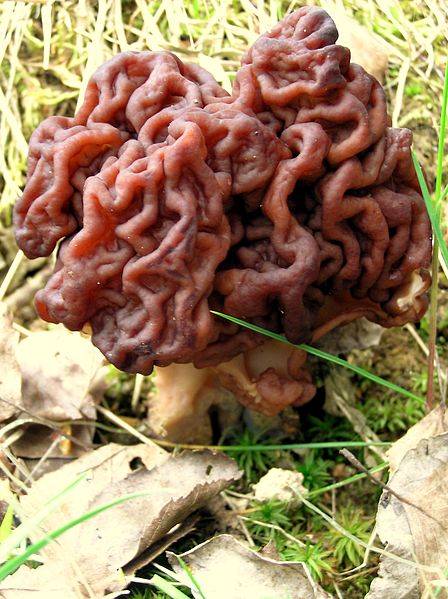
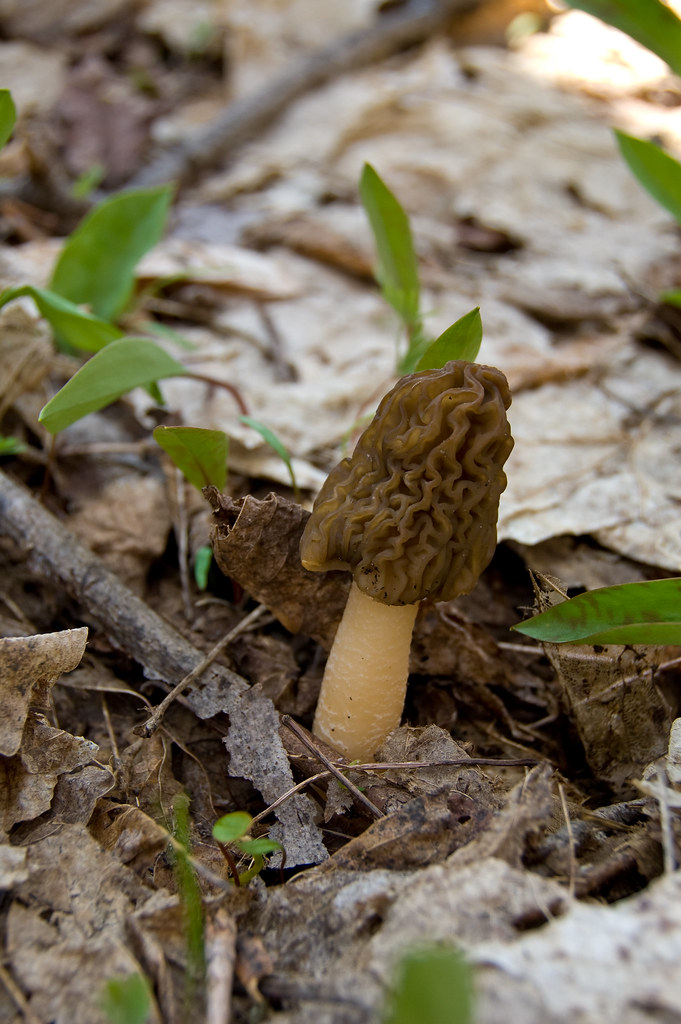
Morels are fairly easy to identify.  They look like a honeycombed sponge, they're hollow, and their cap is fused to their stem.  The two most likely lookalikes that might throw you off are the False MorelGyromitra esculenta 
File:Frühjahrslorchel.JPG
and the Early MorelVerpa bohemica,
both of which are potentially toxic.  Best not to mess around with questionable fungi, as a good general rule of thumb. 
5.  Be a Smart and Considerate Harvester
This goes beyond the good practice of giving other pickers their space.  It's a harvest, not a raid.  There are a few simple techniques to ensure the patch you pick will keep producing in the future.  Never rake forest litter in search of buried mushrooms; this disrupts the soil and results in overharvesting.  Pluck the mushroom off just above soil-level (with your fingers, not a knife!), so as not to disturb the mycelial mat underground.  Don't pick really tiny mushrooms.  Tread lightly; compaction can be devastating to burn areas, especially when the soil is wet.  The goal is to cultivate future mushrooms by protecting the mycelium and encouraging spore dispersal.  You can scatter spores by using baskets to collect (as opposed to buckets or bags), and by leaving big gnarly specimens where you found them, free to live out their old age throwing spores to the wind.
6.  Don't get Caught with your Pants Down
Rules, rules, rules.  Morel hunting is so popular, there are a whole slew of regulations to keep it from running amok.  The rules vary according to region.  You'll definitely need landowners' permission, and you might need a permit on state land.  Last year, I got a free recreational permit from the Bitterroot National Forest offices, which allows us 5 gallons per day per person, up to 20 gallons for the season.  There are fees and different regulations for commercial permits. 
7.  Share the Bounty
To be honest, the thrill of the treasure hunt is the real reason I do this.  For me, finding the little camouflaged jewels in the burnt rubble far outweighs the feast that awaits.  But yes, they're delicious and earthy and wild-tasting, a forest delicacy teetering between primitive and oppulent.  Share them with friends.  It somehow improves the flavor. 
 Hill's Morel Mushrooms has a great summary of how to process and store your harvest.  Also visit this super-handy Inciweb site to follow active burn areas. This blog post was originally created for the Montana Natural History Center.  Click here to read the original post.  And with that, this stinky picker is beat.  Happy hunting to you all!  

March 3, 2013

Ponderosa Pine


Becoming deeply familiar with this tree, the most regal of pines, will almost certainly lead to a richer, more fulfilling life, and offer many new ways of seeing the world.
Ponderosa Pine
Pinus ponderosa
Pinaceae (Pine Family)

Quick ID:  Luckily, ponderosas are pretty easy trees to pin down.  They're giant, regal evergreens with thick, straight trunks.  Branches of older trees are clustered toward the top, developing a distinctively massive bole (the part of the trunk below where the branches start).  A ponderosa's branches are relatively short for its stature, and turn up at the ends.  Needles are 5-10" long, in fascicles, or bundles, of 3 (sometimes 2 or 5 depending on the variety).
From a distance, it's easy to distinguish long-needled ponderosas from other, shorter-needled evergreens.    Up close, you can recognize them by their orange puzzle-piece bark with its deep black furrows.  Be sure to stick your nose into these crevices in spring and sniff the rich vanilla-scented sap running under the bark.
Like all Pinus members, the female cones are hard-scaled, as opposed to the soft paper-scaled cones of conifers like spruce (Picea).  They're armed with a poky prickle and open in fall to release tiny winged seeds.
According to the Utah Forest News, the oldest ponderosa in the world is in the Wah Wah Mountains, and is at somewhere around 940 years.  The National Register of Big Trees says the tallest (of the interior variety) is right here in Lolo National Forest and was 194' as of 1997. 


Range:  This is the most common pine in North America, and is widespread throughout the west, from BC to Mexico and east through the Black Hills.  It covers 38 million acres across 14 states.  Interior ponderosa is most common around 6000-8500', found randomly spaced in open grasslands at lower elevations, with stands becoming denser as elevation increases.  Check out the USDA range maps and some details on regional varieties here.


What's in a Name?  Ponderosa is also known as Western Yellow, Bull, Blackjack, Western Red, Sierra Brownbark, Heavy, and Western Pitch Pine.  According to Flora of North America"Its wood is more similar in character to the white pines, and it is often referred to as white pine. The taxonomy of this complex is far from resolved."  What we do know is this...  
1.  It was named for its heavy, "ponderous" wood in 1826 by the fascinating botanist David Douglas, from a specimen found near present-day Spokane.
2.  The common name "pine" (and genus Pinus) ultimately derive from the Sanskrit pituh, "juice, sap, or resin", the Greek pitys, "pine tree", and Latin pinguis, "fat".
3.  There are basically three varieties:  P. ponderosa var. ponderosa, found along the Pacific Coast, P. p.var. arizonica in the southwest, and the widespread interior variety, P. p. var. scopulorum (that's the one we have here in Montana, and the one I'm referring to in this post).  They differ in size and fascicle number, but also overlap in morphology and distribution, and vary by latitude.  As you can imagine...the taxonomy of this complex is far from resolved.
Tidbits:
Ponderosa is the most commercially important timber tree in the west, and has played a huge role in the region's economic development since the early pioneer days.  The lumber was used intensively for building homes, railroads, telegraphs and mine bracing, and is still considered great for construction.  In 1949, the Montana Federation of Garden Clubs convinced the Legislature that the Ponderosa was the "King of the Forest".  It was adopted as the Montana state tree that same year, and we've all celebrated ever since.Equally important is P. pine's essential role in the ecology of western North America.  The behemoths create a mosaic of open stands filled with understory browse, interior woodland food and cover, and snags for cavity nesters and hunters.

Next time you're standing by one of these old trees, think about how incredibly well-adapted it is to the surface fires that naturally occur in this area.  The branches prune themselves up and out of reach.  Even then, the needles cluster tight around vulnerable growing branch tips, and open loosely farther up to discourage flames.  The bark is thick and insulative, as are the scales covering the buds.  The roots are deep, the size of lodgepoles themselves.  Regular low-intensity surface fire opens the canopy to light and burns up the thick layer of plant debris that builds up on the ground, encouraging graminoids (grasses) to germinate in the nutrient-rich, ashen soil.  It also thins out young trees, particularly the less fire-resistant ones.  It may go without saying that trees in crowded interior stands where fire has been suppressed are much more susceptible to catastrophic crown fires.  In the competition for space, they develop thinner bark and more compact foliage, and the closed canopy creates a dense understory of combustible "ladder fuels".
Anthropogenic factors like dense stands and stagnated nutrient cycling in the absence of fires, coupled with prolonged drought, have led to supreme stress on interior ponderosa ecosystems.  As a result, P. pine is susceptible to a slew of pests including Dwarf Mistletoe, insects like Pine and Bark Beetles (Dendroctonus and Ipsspp.) and wood decaying fungi like red rot and western gall rust.  The Forest Service has this to say:
"Besides unprecedented, large-acreage severe fires, other ecological consequences of fire suppression in interior ponderosa pine ecosystems include:

  • decreases in soil moisture and nutrient availability
  • decreases in spring and stream flows
  • decreases in animal productivity
  • increased concentrations of potentially allelopathic terpenes in pine litter
  • decreases in productivity and diversity of herbaceous and woody understory species
  • decreases in tree vigor, especially the oldest age class of pines, and
  • increased mortality in the oldest age classes of trees"

    The ecological changes in Ponderosa forests that have occurred in the last century as a result of fire exclusion, overstory logging and heavy grazing are a well-documented, fascinating and perhaps scary story that everyone in the west should be familiar with.  

Fire rolls through a Salmon River ponderosa pine stand in the River of No Return Wilderness, Idaho

Wild Gardening
Despite the complicated (and controversial) state of ponderosa forest ecology, the fact remains the this pine is extremely well adapted to the soils, temperatures and moisture regimes of the west.  Try planting P. pine to establish windbreaks or as an impressive ornamental, if you have the space (they grow 60-150' in cultivation).  You can collect not-quite-open cones in late summer, and dry them on racks to release the seeds.  Sow your untreated seeds in late fall; you'll have better luck if you start them in containers before you put them out in the ground.  You'll be providing food and cover for all sorts of wildlife, and will be rewarded with the company of the most awe-inspiring of trees.
You can read an incredibly detailed and fascinating account of ponderosa ecology here.
This blog entry was originally created for the Montana Natural History Center.  Check out the original blog post here.