Showing posts with label Weeds. Show all posts

March 15, 2014

Welcome back, Spring!

Happy Ides of March, everyone!  I'm back after a solid winter break, and pretty excited to be packing away my long undies and sharpening up my garden tools.  It's been a badass winter...
Here's my back yard, June 1st a couple years ago versus March 1st this year.  All that snow is from one day, btw, and is well over ten feet high.  It was an excellent blizzard, and after a day of subzero temps and howling yowling winds, the weather is pretty much back to normal for this time of year.  Sunny skies mixed with some drizzly rainshowers, and temps in the glorious mid-50s.
A hike on Waterworks Hill yesterday told me that the bitterroots are out in droves.  I found hundreds of the bright green anemones tucked into the rocky northeast slopes.  Now I'll start keeping my eyes peeled for buttercups, draba and Rocky Mountain douglasia.  The earliest spring wildflowers are some of my favorites.
Draba verna, each flower no bigger than a grain of rice.
I'm starting up a new project with Watershed Consulting, hunting for Mecinus janthinus, the biocontrol weevil that attacks the noxious weed toadflax.  The hard cold temperatures this winter (we had two good stretches where it was under 20 below zero) killed off quite a few bugs, which overwinter as adults in the toadflax stems.  Our plan is to find stems that were hidden underneath the snow during those cold snaps.  Hopefully the snow will have provided some protection from the frigid temps, much like an insulating blanket.  We'll see!  Once we find the weevils, we'll pack some of the population up and ship them out. The simple version of how biocontrol projects like this work is this:
Linaria dalmatica, Dalmation Toadflax
A non-native plant moves into an area where it has no natural predators, nothing to check its growth.  In some cases, this exotic plant turns out to be such a good competitor that it starts displacing the native plants of the area, which in turn has a devastating ripple effect on the local ecosystem.  The plants that have really really bad environmental and economic effects get deemed official "noxious weeds," and are thereafter subject to some government regulations.  One of the ways we try to control these noxious invaders is through the use of biocontrols...in other words, introducing predators that will attack the weeds and slow their population growth.  Like a weevil, that eats toadflax.  It's a long, somewhat complicated process (you can imagine the risks involved in introducing another exotic species into the environment) but in the end, biocontrol agents really do work as a weed management tool.  So we introduce the bugs, let their population build up to a healthy level, then collect some and ship them to other parts of the state that have the weed but not yet the weevil.  And so on and so forth.  
Matt, from my 2013 Youth in Restoration crew, getting biocontrol weevils ready to ship.
It's a fascinating and effective process, and one that I'm really excited to learn more about.  Over the next few weeks, you'll find me out in the hills, rambling through weedy patches, slicing stems and looking for Messinus.  Did they survive more on north or south slopes?  Low or high?  Big stems or small?  The Bitterroot Valley or the Swan?  So many questions.  I'll let you know how it goes.
In other news, I'm still building wild bee houses, and now is the season to order one!  You can visit my Flora montana Etsy shop, or pop in to one of the Missoula businesses that carry them (the Naturalist's Mercantile and The Buttercup Market and Cafe, at the moment).  I have woodblock photography and bee houses on display (and for sale!) at the Montana Natural History Center through the end of April, and will be setting some stuff up at Bad Goat for a First Friday show in May.  And of course, feel free to drop me a line if you'd like to order one directly from me!  I'd love to hear from you.  Happy spring, everyone.  I'll be back soon with the first of this season's Plant Profiles.  Keep in touch.

September 4, 2013

Western Yarrow

Western Yarrow
Achillea millefolium
Asteraceae (Sunflower family)

Quick ID
Yarrow forms a spreading carpet of soft, fern-like leaves that grow 3-5" long and have a little silvery tinge to them.  The flower stalks can get to be 3' tall (shorter where it's shaded) and are topped with clusters of creamy white flowers.  Leaves and flowers alike have a distinctive smell, kind of sharp and pungent.
At first glance, the flowers of the native White Spiraea (Spiraea betulifolia) look an awful lot like yarrow, but on closer observation they're pretty different.  Spiraea flowers (on the right in the photo above) have long stamens that waggle out past the petals, and the leaves are broad and toothed.
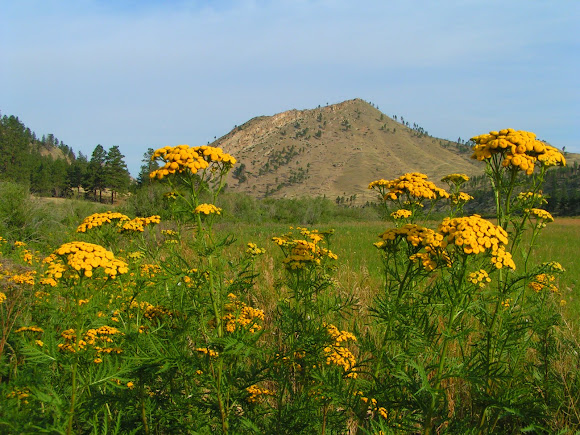
Tansy, blech!
There are plenty of non-native yarrows grown and sold at nurseries.  These are the yellow and pink-flowered varieties, and they have a strong tendency to be weedy in gardens.  There is also an invasive weed called Common Tansy (Tanacetum vulgare) that's often mistaken for yarrow.  It looks similar, but only in the crudest sense.  Tansy is a pretty plant, but, ahem, a HUGE pain in the ass, devastating to native plant communities, impossible to get rid of, etc etc.  Don't grow it.  Don't pick a bouquet and give it to your honey.  I see you looking at it with those doe eyes.  But it's so yellllowww...!  Quit it.  It's bad.  Tell your neighbors.

Range
Western yarrow is circumboreal, meaning it occurs all throughout the northern (boreal) latitudes of the globe, including every state and province in North America.  You find it especially in the west and central parts of Montana, in habitats ranging from streambanks to open hillsides to wooded forests.

What's in a Name?
Everything about yarrow is steeped in rich history, and its name is no exception.  The common name comes directly from the old Saxon word for the plant, gearwe. The genus Achillea honors the Greek hero Achilles of the Trojan wars, and hints at this plant's long importance as a medicinal herb.  Achilles was taught of yarrow's healing properties by Chiron, his centaur tutor.  Achilles had no need of it himself, of course, having been rendered invulnerable to wounds due to a good dunking in the river Styx as a baby.  The only spot that remained vulnerable was the small place where his mother Thetis pinched his heel as she dipped him in the water, and this is where Apollo shot the arrow that was the death of him.  (Turns out Apollo was also the one who taught Chiron all that good stuff about plant medicines!  Hmmm...)  Anyhow, during his life as a war hero, Achilles is said to have carried the yarrow plant with him into battle to heal his soldiers' wounds.  The fresh leaves are indeed a clotting agent, and can be used to staunch nosebleeds and bloody scrapes.   For this reason, yarrow has also been known in the past as bloodwort, sanguinary, soldier's woundwort, stanchweed and thousand seal.  The name for this blood-clotting alkaloid is achilleine, which is still used in modern medicine to suppress menstruation.
The species name millefolium literally means a thousand leaves, and leads to another common name for yarrow, "milfoil".  Also included in the long list of traditional names is death flower, eerie, bad man's plaything (!), old man's mustard, seven year's love, knyghten, snake's grass and devil's nettle.
Tidbits
Yarrow isn't considered a great grazing plant for domesticated or wild animals.  It's one of those "they'll eat it if they have to" plants, which makes it good for landscaping where deer are a problem.  Milk from cows that graze on yarrow is considered "disagreeable" tasting, and I can tell you from experience that honey from a yarrow patch tastes...really weird.  Very strong.  Disagreeable, you might say.  In fact, the alkaloids, volatile oils and glycosides in yarrow are so apparent, so in your face, that some people just can't stand it.  Late in the summer, when the white flower clusters are starting to brown, the smell coming off a yarrow stand is strong.  "Literally smells like vomit," says a friend of mine.  Whelp, says I.  Smells like yarrow.  You either love it or you hate it.  For me, it's both at the same time.
Those same smelly chemicals are what has made yarrow such an illustrious plant for thousands of years.  The medicinal properties go on and on.  Besides being a blood coagulant, it's also reported to be a good anti-inflammatory chest-rub for colds, induces sweats to break a fever, eases toothaches and earaches, soothes burns, brightens your eyes and repels mosquitoes.  I believe it.  If you dig up a bit of yarrow, you'll see little pink tips on the roots.  Chew on these.  They taste like carrots and make your tongue go all numb and tingly.  There are powerful chemicals at work in this plant.  I've never seen anyone poisoned from it, but it could happen.  Don't say I didn't warn you.  I have seen it be irritating to some people's skin.

Wild Gardening
In many ways, yarrow is a wild gardener's dream.  It's so easy to grow from seed.  Just wait till the flower heads are brown, shake them off into a bag, and make sure they're good and dry so you don't get mold.  The seeds don't even need cold stratification; you can just sprinkle them on any old soil and they'll grow like gangbusters.  They also transplant like nobody's business.  I've literally yanked yarrow out of my yard, thrown it onto a patch of roughed up ground, done a two second "cover up, smoosh down and water," and had a healthy new yarrow patch within a week.
Obviously, this plant is tenacious.  In an irrigated yard, it will take over if you let it.  Maybe that's a good thing!  I'm letting a chunk of my lawn get taken over this summer.  It's nice because you don't have to mow it (it's a wildflower!) but if you do, it's fine.  Just nice soft ferny lawn.  Never have to water or fertilize.  But this tenacity also means that stray yarrow plants are constantly popping up in every other part of my yard.  I'm semi-okay with it, because the foliage is nice and I don't have to feel bad about ruthlessly yanking it out when it's gone too far.  And it will go too far.  So if you want a tidy controlled environment where everybody follows the rules and steps in time, yarrow's probably not for you.  If you want a crazy-easy native plant that needs next to nothing in terms of upkeep, look no further.  In fact, if you don't irrigate at all (and live in a really dry climate like ours) yarrow will be much less of a pain.  So really what you should maybe do is go native, quit watering, and embrace wholeheartedly the plants like these that thrive on neglect.
Also, make sure you like the smell before you plant a bunch.  Some people don't.
The pollinators love it though!  Prolific flowers, nice big landing pad for bees and butterflies, and a long bloom season.  The seed heads look really nice if you don't cut them, too, and add great winter interest to your landscape.  Oh, yarrow.

One More Thing...
I don't suppose I've mentioned, here on Flora montana, my great love of story songs and old folk ballads, but there, I've said it.  Oh I love them, and an old Scottish standard, The Dowie Dens of Yarrow, just happens to be one of my favorites.  Especially Ewan MacColl's version.  So good.

May 11, 2013

Boxelder Maple


Boxelder Maple
Acer negundo
Aceraceae (Maple Family)
Quick ID:  
A relatively short (~30-50') tree, usually with multiple trunks, growing in moist woods and along streambanks.  The Boxelder is the only maple in North America whose leaves are compound (divided into parts - in this case usually 3). 
Acer negundo is dioecious (from the Latin "two houses") meaning the individual trees are distinctly male or female.  This is easy to distinguish in early spring when they're flowering:
                                                          Female pistillate flowers

Male staminate flowers

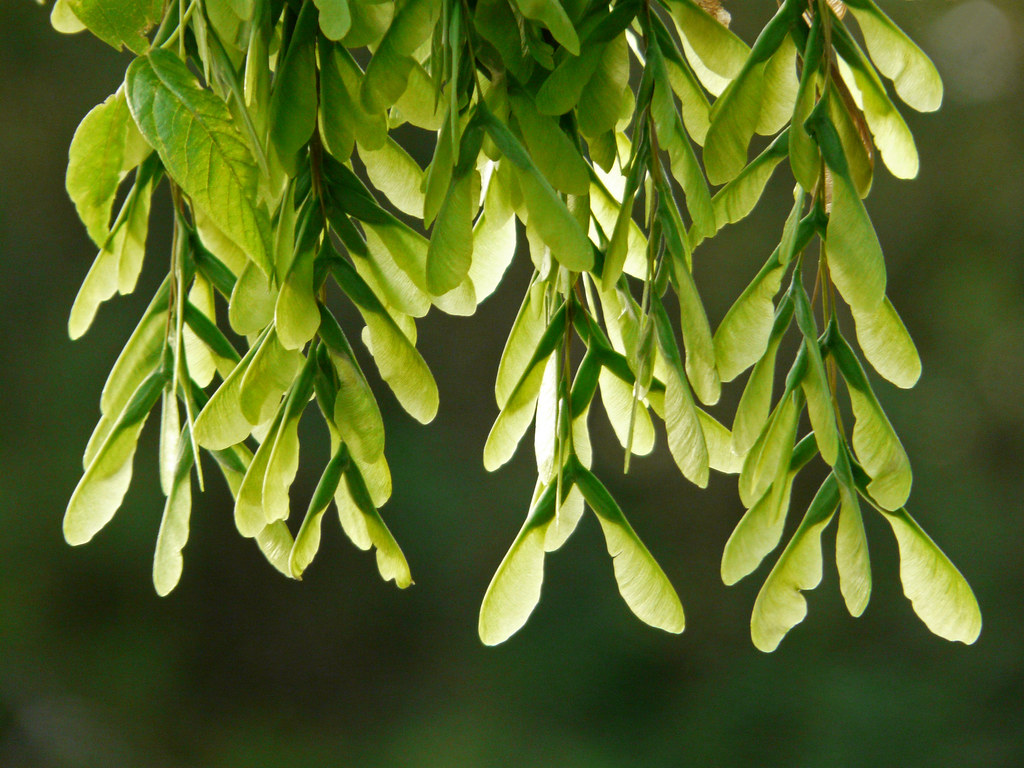
Only the female trees make the "helicopter" fruits common to maples (technically known as samaras, also called keys), and only if there is a male nearby. 
In winter, they're easy to recognize by their chubby, opposite buds; the twigs are fresh looking, green or purple, and covered with a fine fuzz that's easy to rub off.
The wood is abnormally soft for a Maple, and branches tend to break off easily, making this a somewhat scraggly tree.
Range:
The most widespread maple in the world, stretching from Ontario south to Guatemala, with a native range that covers a wide swath of North America.  In many parts of the US, especially eastern states,  it's considered a pesky tree at best; in Australia it's officially considered an invasive species.
What's in a Name?  
Acer means "sharp", in reference to the normally hard wood of maples, which the Romans used for spear shafts.  Negundo is a Sanskrit word referencing the resemblance to Chastetree (Vitex negundo).  The name Boxelder (or Box Elder) comes from the leaves' similarity to Sambucus (Elder) and the white wood's likeness to Boxwood (Buxus sempervirens).  A few sources say it's named for the fact that people make boxes from its soft wood, but I'm not buying it.  
This is also commonly known as Manitoba or Ash-leaf Maple.  In Spanish it's Fresno de Guajuco.   
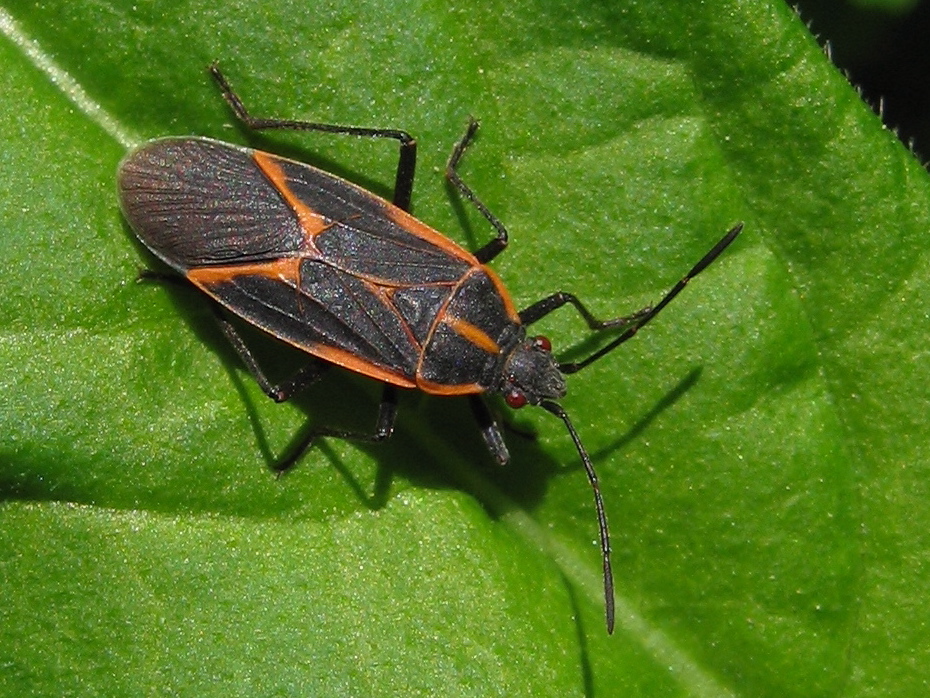
Tidbits:  Acer negundo is most famous for its relationship to the Boxelder bug (Boisea trivitattus).  There are many myths and misconceptions floating around about these little critters, so let's break it down.
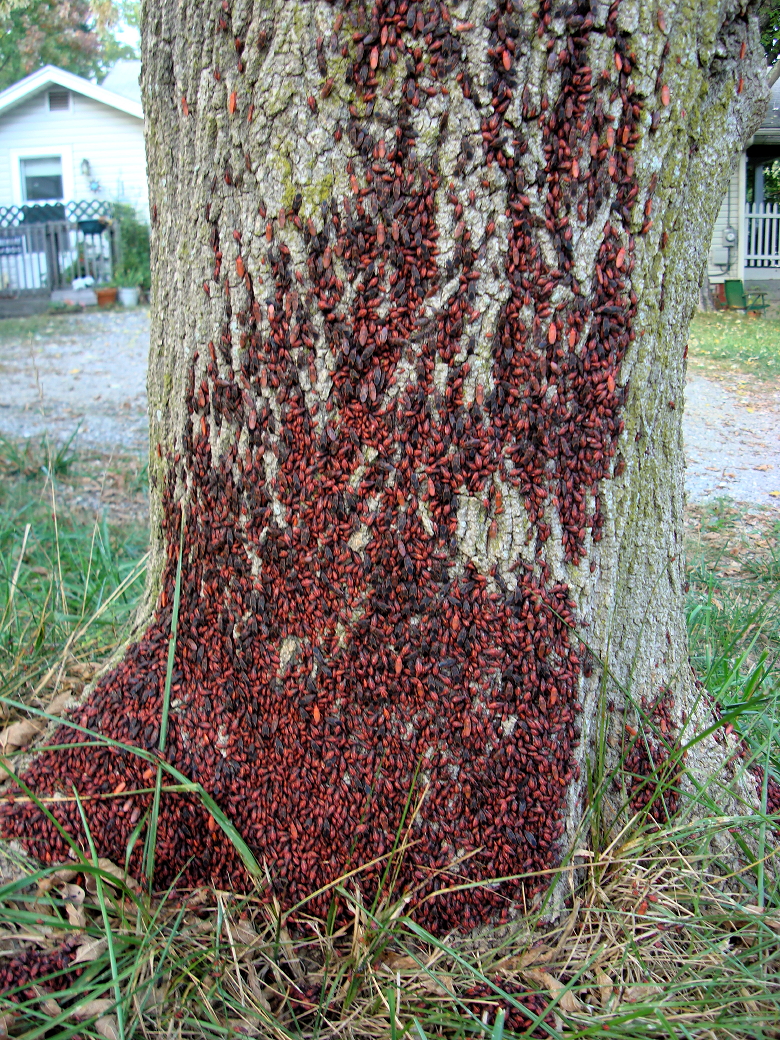
1.  Boxelder bugs are found on all kinds of maple and ash trees, but greatly prefer Acer negundo.  Only the female trees are hosts to the bugs.  They feed on low vegetation in spring, lay eggs all over the tree in mid-July, and start to move toward overwintering sites in fall.
2.  These overwintering sites may very well be your warm, cozy house!  Some buildings are more susceptible to the invasion- namely, the sunniest ones (tall, good southern exposure).  Adults can travel up to two miles in search of a winter home, so chopping down the Boxelder tree in the front yard might not save you (although it may help).
3.  They don't bite.
4.  They don't cause any noticeable injury to their host trees.
5.  It's highly unlikely they'll gobble up your house plants.
6.  They might leave streaks of poo on your walls and curtains.  This is probably their greatest fault.
7.  The best defense is offense.  For a great reference on what you can do to seal up your home, see this U-MN Extension publication.
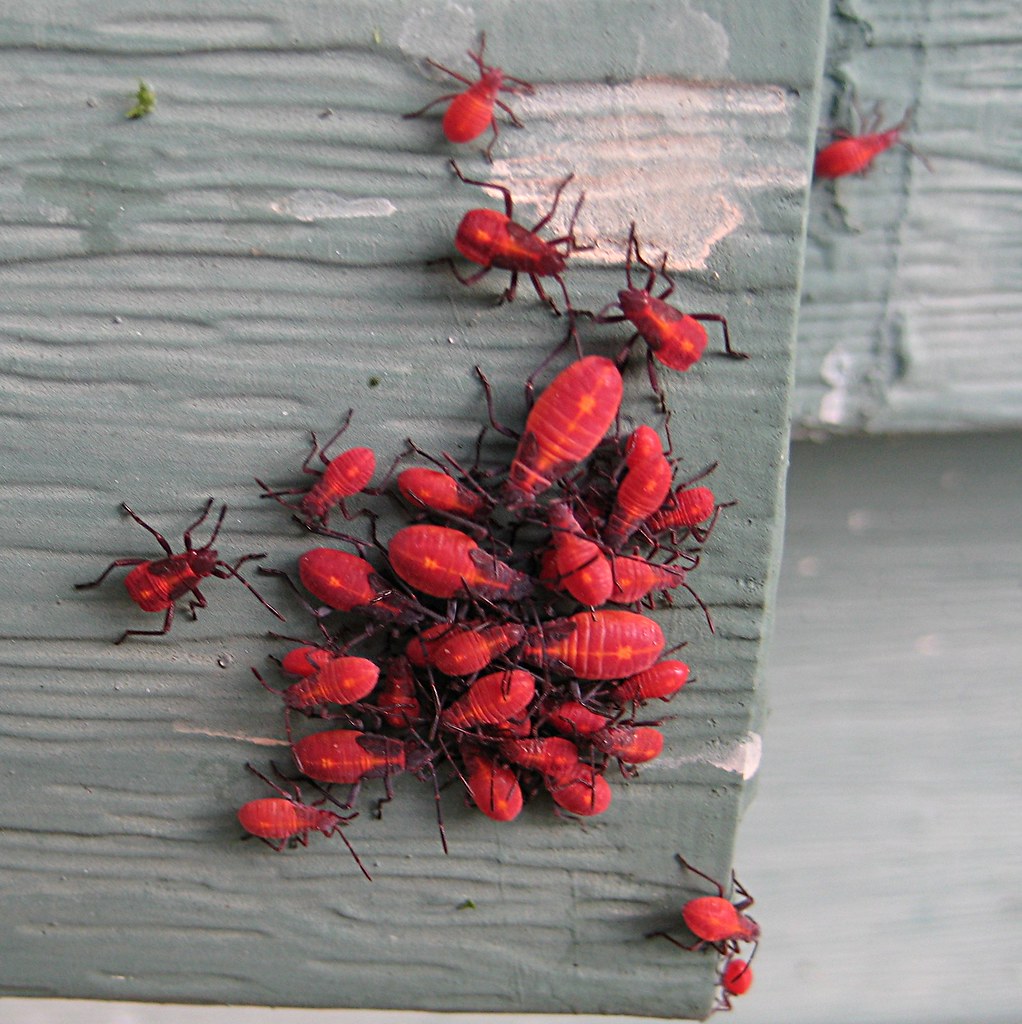
8.  You can find piles of the bright red nymphs throughout the summer.  They're harmless, fascinating insects to observe.
Boxelder is highly sensitive to 2,4-D (a common herbicide), and is susceptible to fire and mechanical damage due to its thin bark.
The wood is used for fiberboard, cheap furniture, pulp and fuel.  You can tap these trees in spring to produce maple syrup.
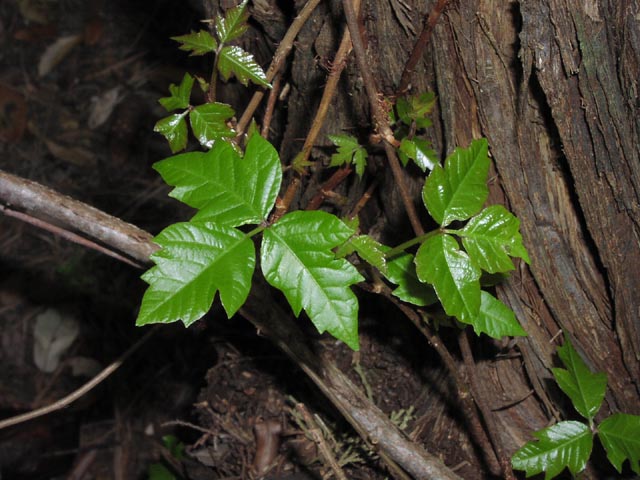
Seedlings and young saplings look a lot like Poison Ivy (Toxicodendron radicans).  The top photo here is a boxelder.  Notice the bottom poison ivy has really shiny leaves.  Not a perfect identifying feature, but a decent starting point.


Wild gardening:
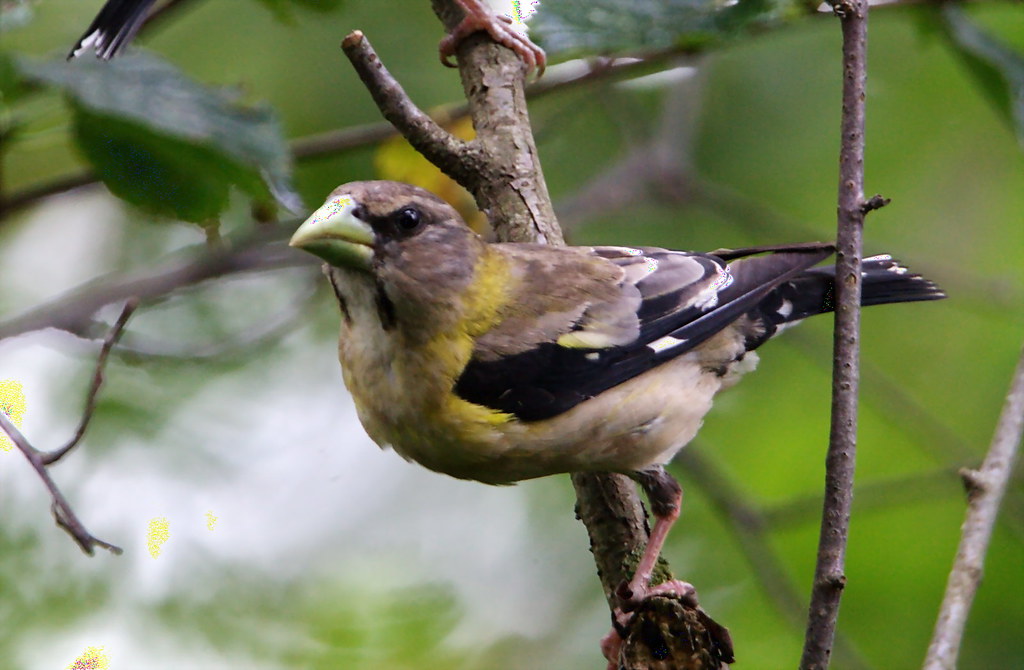
This is a fast growing, short-lived tree (avg. 60 yrs) that's hardy to Zone 2 and highly drought tolerant.  With it's prolific seeds and ready establishment, it has a tendency to become weedy or invasive.  It also suckers like crazy where branches have been cut or broken.  Maybe not the best choice for a tidy lawn, but fine for naturalized areas in the west.  In fact, it provides essential habitat factors for backyard wildlife.  Besides Boxelder bugs, it's a larval host to Cecropia Silkmoths (Hyalophora cecropia-mostly found in the east).  It's wind-pollinated but also visited by bees.  Squirrels and many birds, particularly the Evening Grosbeak (Coccothraustus vespertinus), feed on the seeds.


May 5, 2013

Fuller's Teasel

Fuller's Teasel
Dipsacus fullonum
Dipsacaceae (Teasel Family)


Quick ID
Prickly thistle-like plants that are generally about five feet tall, although I've seen plenty reach the ten foot mark.  They're biennials, forming a rosette of leaves the first year and flowering the second season.  Flowers are light purple little tubes tucked into a spiny seedhead that perches atop the bristly stem like a pinecone.
Range
Fuller's teasel is native to Europe, and was first cultivated in the US in the 1800s.  It naturalized quickly and is now found growing wild all over the country, except in the northern Great Plains and some states in the southeast.  Look for big patches in moist areas by roadsides and other places where the soil has been disturbed.

What's in a Name?
The genus Dipsacus comes from the Greek "dipsa," meaning thirst.  This is in reference to the leaves, which close around the stem to make a little cup where water collects. Studies have shown that the more insects that land in these cups, the more seeds a teasel plant will form, which implies that Dipsacus is at least partially carnivorous.  Rawrrr!
The species name is fullonum, pertaining to fullers (people who cleanse and process wool into cloth).  Traditionally, dried heads of teasel were used for this purpose, attached to spindles and "teased" through wool to clean out dirt and raise the nap of the fabric.
Nowadays the industry uses wool cards (which look like a brush for a kitty), but some purists use the pointy, hooked seed heads still today.  Apparently, when there's a lot of resistance in the fabric, the easily-replaced teasel head just breaks, whereas metal cards will rip the cloth.
Tidbits
The stems of teasel are hollow, making them perfect for building a Wild House of Bees!  In spring, solitary cavity-nesting bees will fill these tubes with a row of eggs, which will hatch and pupate over the summer.  The young bees spend the winter in the stems, and emerge in spring to begin the process anew.  They survive by feeding on a little pollen reserve (or in the case of wasps, a meaty little insect body) left by the mother in the nest cells.  Did you know that insects in the order Hymenoptera (bees, wasps and ants) are the only insects in the world that provide food for their offspring?  Awesome.  
Wild Gardening
By most accounts, you probably shouldn't grow teasel in the garden.  It's at least some level of noxious weed in Colorado, Iowa, Missouri and New Mexico, and has invasive tendencies wherever it gets established.  That said, the spiny seed heads are awfully pretty, and especially nice for dried flower arrangements.  But remember that human dispersal is the number one way teasel seeds are spread, and once it gets out into the environment, it can quickly crowd out native plants.  Using dried seed heads in floral arrangements that are going to leave your house is probably not a good idea.  Better idea--find a wild patch, pull up the stalks, trash the seed heads, and use the stems to build little native pollinator habitats.  Everybody wins!