Showing posts with label Berries. Show all posts

February 23, 2015

Rocky Mountain Juniper


Rocky Mountain Juniper
Cupressaceae (Cypress Family)


Rocky Mountain juniper.  Appressed leaves.
Quick ID
Rocky Mountain juniper is a small conical tree that grows to be around 30' high.  The bark is raggedy and shredding, reddish-brown to gray.  Its leaves are actually made up of thousands of tiny little needles, about 2 mm long.  If you look close, you'll see that some of these needles stick out all over the stem like a Doug Fir.  These are the juvenile leaves.  Mature leaves are squashed up flat against each other (known in the botany world as appressed), layered like shingles on a roof.
Common juniper.  Nothing appressed about these leaves.
There are three other species of juniper native to Montana.  Common juniper (J. communis) is a small shrub that's easy to recognize.  Its needles aren't apressed; they go poking out all around the stem in whorls of three, and have distinctly white undersides.
Creeping juniper (J. horizontalis) has leaves much like the Rocky Mountain juniper, but it grows in dense mats, never more than 2' tall.  The leaves are usually a dark green, whereas J. scopulorum tends to be more blueish-gray.  And finally, the Utah juniper (J. osteosperma) is another 30' tree.  Everything about it somehow seems more blunt: broader needles, a squarish crown, and a generally more squat appearance.  In Montana, you'll only find it in Big Horn and Carbon counties, south of the Pryor mountains, where it's at the northern edge of its range.
~Western Red Cedar~
You might confuse juniper with the western red cedar (Thuja plicata) in northwest Montana.  The leaves are similar, but the branches are more flattened, spray-like and brighter green.  The cones are also woody, whereas juniper bears seeds in what look like blue berries (they're technically female cones).  Juniper "berries" form in May or June and take two years to mature; you'll find green immature berries all over the branches along with the blue ones, which are usually covered with a white bloom.  If you're looking to harvest the berries, remember that, unlike most trees, junipers are dioecious (from the latin for "two houses"), meaning that individual plants are either male or female.  
"Male Bark"
Only the female plants have berries; the male ("staminate") cones just look like little brown nubs at the tips of branches, which scatter pollen to the wind.  Female trees also tend to have shreddier bark, as opposed to the patchier bark on males.
What's in a Name?
The species name of Rocky Mountain juniper, scopulorum, comes from the Latin 'scopul'  meaning rocky crags or cliffs, which is just where you'll find these bristly trees on your botanical field excursions.The origin of the common name juniper (and genus Juniperus) is shaky.  I've been combing through a lot of suggestions this morning, some silly and some sensible, and I'm not sure who to believe.  I do love the salty old etymologist Bill Casselman's take on the topic as a whole, and found this article pretty enlightening.Juniper is also becoming a popular baby name.  Ultimately, the given name is probably not derived so much from the plant as from the Welsh name Guinevere (which also gave rise to the name Jennifer).
Gorgeous juniper habitat on the Madison river
Range
Look for Rocky Mountain Juniper in dry, rocky foothills and montane regions from BC and Alberta south to New Mexico and east to the Dakotas.  The range is extended somewhat due to the fact J. scopulorum hybridizes regularly with other juniper species and horticulturally cultivated varieties. 
Tidbits
Junipers, along with other members of the cypress family, have been around for a looooong long time.  Ever since the earth's land masses were clumped together in the super-continent  Pangaea, 250 million years ago.  This is why you can find the very same species, Juniperus communis, as a native shrub in North America, Asia and Europe.  This ancient plant, as you might expect, has a rich and fascinating history.Juniper's light, durable wood is naturally streaked with a lovely red and white grain, and makes fine tools and decorative utensils.  The shredded bark has been used in rope-making and padding for diapers.  The dried berries can be dried and strung into necklaces; Navajo mothers are said to have given these "ghost beads" to their babies to prevent bad dreams.
The berries and aromatic branches of the juniper have also been used medicinally since ancient times (the Greek physician Galen mentions it as early as the second century AD), for a list of ailments too long to go into here.  The essential oil does contain the diuretic compound terpinen-4-ol, as well as Amentoflavone, which has antiviral properties.  Juniper berry tea has a long, complicated, sometimes dangerous association with child-bearing.  It was used by Shoshone women as a contraceptive, and Zuni and Apache women drank the tea to promote muscle relaxation during labor.  Juniper oil does increase uterine contractions, and many native tribes (and pioneer women) used it to induce abortions, sometimes with fatal results.The berries are not particularly edible on their own, but they do lend their distinct flavor to that most delightful spirit, gin.  The earliest juniper-flavored alcohols were medicinal concoctions,  and would have borne little resemblance to our modern take on gin.  The species most often used in gin production today is the long lived Juniperus communis communis.
Camped out at my favorite (top secret) juniper picking spot
For the most part the berries (a thousand tons a year or more!) are still wild-harvested, coming principally from Tuscany, Morocco and eastern Europe.  Hand picking is long, laborious work because remember, there are berries in all stages of ripeness on each branch.  To only pick off the dark blue berries and leave the green fruit alone requires a lot of elbow grease and some skill with a good whacking stick. Once harvested, the berries are infused into a neutral base spirit (vodka) and violรก!  Oh Captain, my Captain.  Distillers can be a little secretive about their recipes, but common additions often include angelica, orris root (a type of iris that acts as a fixative for other flavors), cardamom, bay leaf, citrus, ginger, grains of paradise (in the ginger family Zingiberaceae), lavender, coriander, fennel and cubeb (similar to black pepper). 
Hogarth's Gin Lane
We could go on and on about the history of gin.  It's production as "medicine" during prohibition.  England's 18th century Gin Craze.  The fascinating story of quinine.  Jenever, Old Tom and London Dry.  Bathtub gin.  So on and so forth.  If you'd like to read more, and in fact discover a whole incredible world of botanicals as they relate to alcohol, please do pick up a copy of Amy Stewart's The Drunken Botanist.  You'll be glad you did.

Wild Gardening

The Garnet Range is a great place to see giant J. scopulorum
The Rocky Mountain juniper is one of our toughest little trees, and is a perfect choice for natural gardens.  The tiers of branches, loosely woven, call the eye upward and beyond the borders, providing structure and texture in every season. Waxy-coated leaves make it incredibly drought resistant and winter hardy.  Junipers want full sun or part shade, and very little water.  If you are going to irrigate, mke sure the soil is really well drained.  Although very slow-growing, give it enough space to accommodate its mature size (about 20-30' high with an eight foot spread).
Try propagating juniper by taking heel cuttings after a couple of hard freezes, and using a rooting hormone.  If you want to try growing it from seed, sow them in the fall and cross your fingers.  It's possible, but expect your germination to be pretty low.  Plants are also readily available at nurseries, but ask questions to be certain you're getting the true native species.  There are a ton of Juniperus cultivars and ornamental varieties.  There might be nothing wrong with that per se, but as a general practice, the more your garden plants resemble the native species found in your area, the better they'll be at providing food, shelter and nesting sites for your local insects and other wildlife.
Juniper berries are relished in fall and winter by many small birds, especially waxwings and grosbeaks.  Junipers are larval host plants for the Juniper Hairstreak butterfly (Callophrys gryneus).  Watch for males perching amidst the branches on your next summer excursion.

July 25, 2013

Red Baneberry

Red Baneberry
Actaea rubra
Ranunculaceae (Buttercup Family)
Quick ID:  
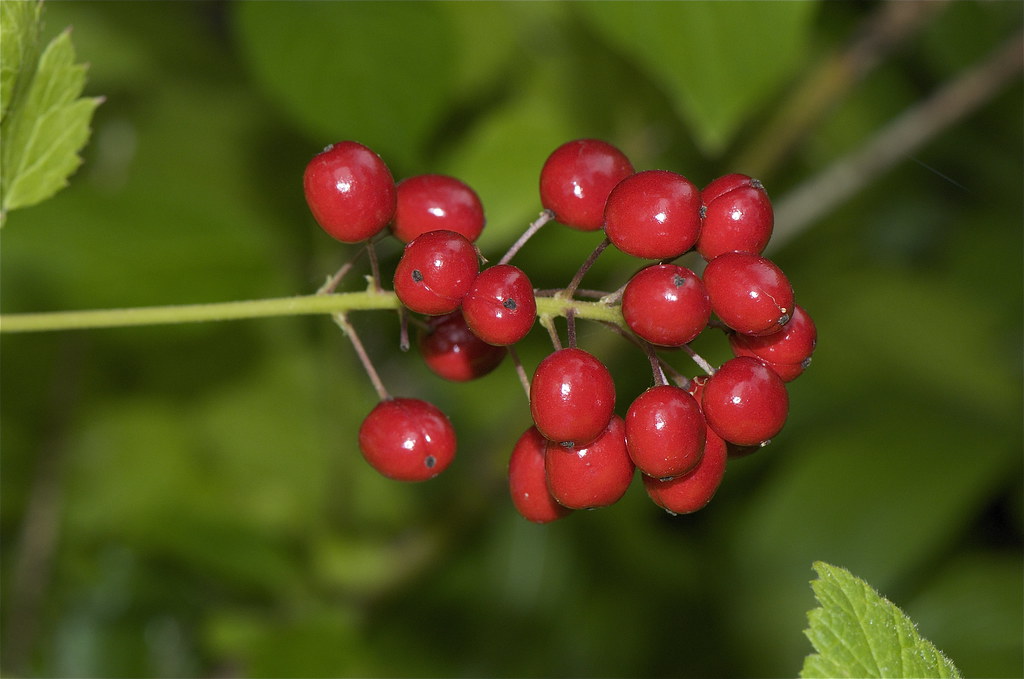
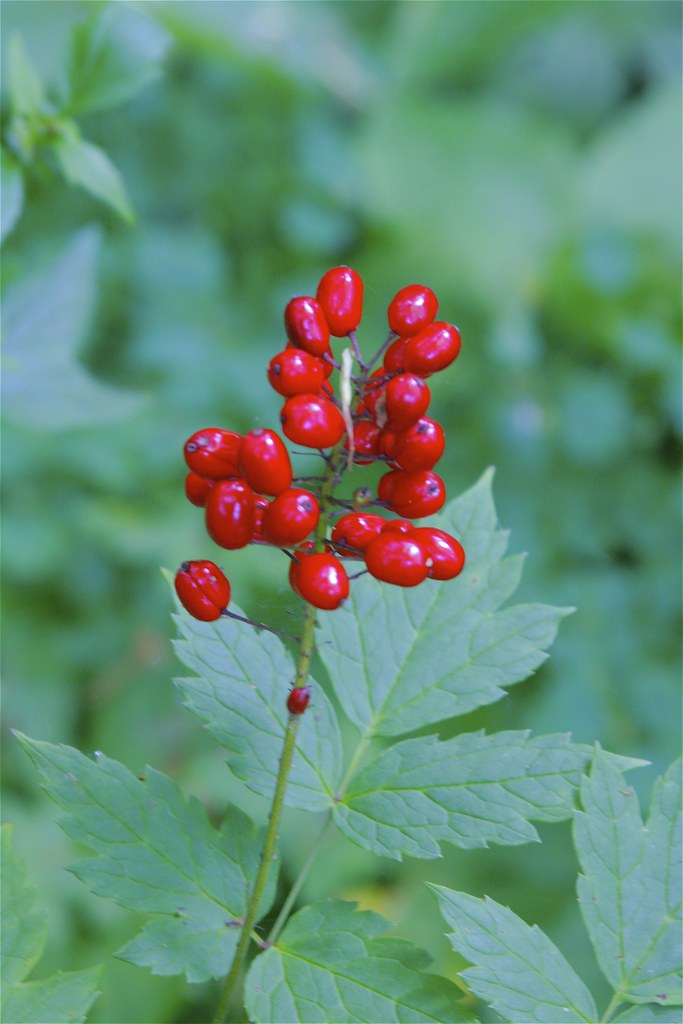
Look in rich, moist thickets and shaded forests for this striking, relatively uncommon plant.  It can grow up to three feet high, with flowers appearing in early to mid-summer as fluffy clusters atop tall stalks.  The white flowers have lots of antenna-like stamens that wave out past the small petals.  Soon, the flowers fade and stalks of bright red berries take their place.
The species and subspecies of Actaea are closely related and not always easy to distinguish.  There is a white baneberry (A. pachypoda), but the red baneberry species (A. rubra) sometimes bears white fruit as well.  True white baneberries have thicker pedicels (flower-bearing stalks) than the "red" species.  You can recognize Actaea berries by the little buttons on their ends.  The white berries, with their pupil-like spots, have been used in the past as eyes for children's dolls, hence one of the common names for the plant, "Doll's Eyes".  Kind of creepy looking, if you ask me.   
Range:
Found through the northern temperate zones of North America and Eurasia.  In Montana, it's most likely to be spotted in the southern and western parts of the state (see the USDA range map)
What's in a Name?
The family name Ranunculaceae comes from the Latin rana, frog, in reference to its members' affinity for wet places.  Actaea is the Latin name for a generally strong-smelling plant.  The Greek aktea is the word for the elderberry tree (Sambucus sp.), whose leaves the baneberry resembles.  Rubra is a ubiquitous species name meaning "red".  The common name "baneberry" refers to its toxicity--bane ultimately comes from the ancient root gwhen-, "to murder or wound".
You might also hear baneberry called red cohosh, necklaceweed or snakeberry.    
Tidbits:
All parts of this plant are poisonous, with the toxin protoanemonin most concentrated in the berries and roots.  Symptoms include "the usual"--vomiting, diarrhea, dizziness, stomach cramps--but the toxin ultimately acts on your heart, and can cause circulatory failure.  So don't eat it!  That said, people have been eating this plant for thousands of years.  North American Indian tribes have used a decoction of the roots to treat rheumatism, coughs and colds, and to improve the appetite.  It is said to increase milk production after childbirth, and decrease excessive menstrual bleeding.  A poultice of chewed leaves was used to soothe wounds, and there are several references to it being ingested to soothe stomach pains caused from swallowing hair. (Huh?)  But once again, unless you're a trained professional, please, don't eat it.  Eating as few as two berries can cause severe pain, and a few more can mean respiratory failure and cardiac arrest.
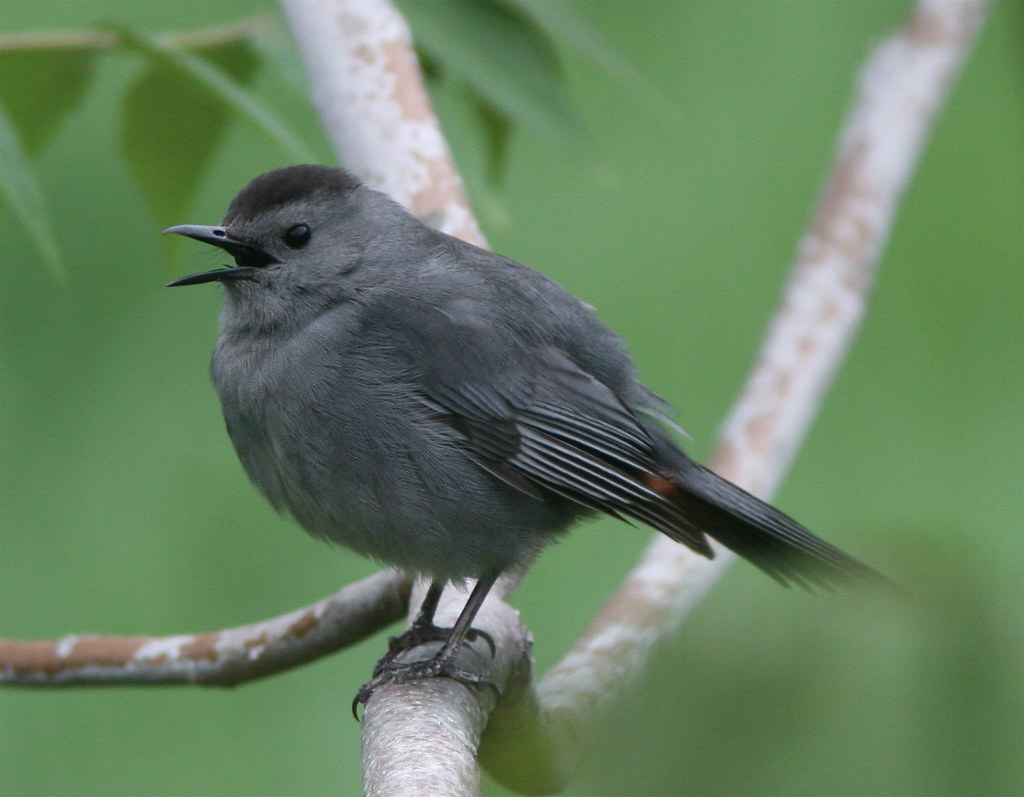
Baneberry is not, however, poisonous to livestock.  Sheep and horses will graze on it when there's not much else around, and elk will eat the foliage in the fall (Actaea foliage stays green late in the season, after most plants have withered in the frost).  Birds like Grouse, Gray Catbird (seen here), and American Robins also relish the berries, as do mice, squirrels, chipmunks and voles.

Wild Gardening:
Despite its murderous name, baneberry makes an excellent woodland garden perennial.  The foliage is lush, the flowers and fruit are highly ornamental, and it can take part to full shade.  It provides cover for small mammals and will attract songbirds to your yard.  Plants are not hard to find at nurseries, particularly those specializing in natives.  If you do decide to try propagating from seed, remember that, like many wildflowers, they need a period of cold stratification before they'll germinate, and it might take two seasons to get them to sprout.  Naturalize along with other moisture-loving species like twinberry, horsetail, thimbleberry, sedge, alder and aspen for a lush, verdant woodland garden.

May 12, 2013

Dwarf Mistletoe

Dwarf Mistletoe
Arceuthobium spp.
Viscaceae (Mistletoe Family)
What's in a Name? 
Viscaceae has the same root as "viscus," and refers to mistletoe's sticky berries, which were historically used to make birdlime. Handfuls of ripe berries were chewed or boiled, formed into long strands and coiled around tree branches. A bird lands on the sticky branch and there he stays, until the bird-eating hunter returns to pluck him off. This is illegal in many countries now, by the way. Birdlime was also used to manufacture British sticky bombs in WWII.

According to some accounts, "mistletoe," originally mistelta in Saxon, comes from three Sanskrit words: Mas (the Messiah), tal (the womb), and tu (motion to or from). This is the first clue to the enormous cultural power Mistletoe has held throughout history. Read on.

Quick ID:   
In Montana, you'll find Dwarf Mistletoe, which looks a bit like coral, clinging to branches of Ponderosa, Lodgepole and Limber Pine, Douglas Fir and Western Larch. It's a hemiparasite, relying on its host conifer for most of its water and nutrients. There are 42 species of Arceuthobium worldwide (21 endemic to the US) that prey on members of the Pine and Cypress families. All have greatly reduced leaves (just scales, really) with the bulk of the plant living inside the host. Here's how it works:


Remember those sticky berries? Well, they're not just built to help ancient bird-eaters trap their dinner, oh no. As the berries ripen, they swell with hydrostatic pressure, which builds and builds until POW! The fruits burst open, sending seeds flying through the air at 50 mph. If they're lucky, these sticky little seeds land on a suitable host plant and get to work. Their root-like "haustoria" grow into the xylem (water pipes) and phloem (food pipes) of the host, thus beginning its slow decline and eventual death.
Sometimes the best way to spot Dwarf Mistletoe is to look for the peculiar "witch's broom" growths it creates on trees. These dense masses of branches could be mistaken for bird's nests, but they're actually just a bunch of branches growing out from a single point, and can be caused by fungi, insects, mites, nematodes, viruses, frost, forest thinning . . . and, of course, mistletoe.


Tidbits:
Folklore and Fables... Dwarf Mistletoe is cousin to the American Mistletoe (Phoradendron flavescens), the leafy plant we all know from the holidays. The mythology of mistletoe goes back thousands of years, far beyond that quick kiss at Christmas.  Perhaps it's because mistletoe's evergreen leaves seem a symbol of everlasting life (ironic, since it's also known as the "Vampire Plant" that sucks the life out of its host).

Throughout history and worldwide, mistletoe is considered a bestower of fortune, aphrodesiac, antidote to poison and curer of ills. In the Christian faith, mistletoe (mistelta) represented the time between the conception and birth of Jesus, and was supposedly "applied" to him as an infant...whatever that means. Mistletoe was considered sacred long before that, however.
  
Roman scholar Pliny the Elder (23-79 CE) wrote of the Druids' relationship with the plant, which they held to be the most sacred of all living things save oaks (the Gaelic word druidh means "oak-knower"). European Mistletoe figured prominently in Greek mythology, and Romanians still use the plant for its magical and medicinal properties. The use of mistletoe at Christmas dates back to the 18th century, but kissing under the mistletoe comes from a Norse myth. The story, basically, is this:

Baldr, god of vegetation, was killed by a spear made of mistletoe. His death brought winter to the world (no good!) so the gods restored him. His mom Frigga declared mistletoe sacred, a bringer of love rather than death. To celebrate Baldr's happy return, any two people passing under the plant now must make the obligatory smooch.

In Scandinavia, it's still considered a plant of peace, under which enemies can declare a truce or quarreling lovers make up.


Medicine... The plant has been purported to cure cancer and epilepsy, among other things. Suzanne Sommers made headlines when she opted for a mistletoe extract (Iscador) in lieu of chemotherapy following her treatment for breast cancer. There are several accounts, however, of mistletoe's poisonous properties that should not be taken lightly!

Ecology... Many Dwarf Mistletoe species are considered to be serious threats to forest health. Severe infection can lead to reduced growth, seed and cone development, poor wood quality, increased susceptibility to disease and insect attacks, and premature death. Most of western North America's commercially important conifers are hosts to at least one Dwarf Mistletoe species.  Interestingly, higher rates of mistletoe infestation have been linked with higher numbers and greater diversity of birds and other animals, perhaps by creating more nesting sites within the tell-tale witch's broom.

April 22, 2013

Currants and Gooseberries

Currants & Gooseberries
Ribes spp.
Grossulariaceae (Currant Family)
Quick ID:  
The many species of Ribes have a few things in common.  Look for deciduous shrubs with alternate, palmately lobed leaves growing along streams and on drier foothills.  The spicy-scented flowers can be white, pinkish or yellow, with petals fused into a tube at the base.  The ovaries are inferior-somewhat more rare in the plant kingdom than superior ovaries.  This basically means that the female part of the flower (that, once pollinated, will swell into a seed-bearing fruit) is located below where the petals and sepals are attached.  
Incidentally, inferior ovaries evolved later in plants; a protective measure to keep the important reproductive parts tucked away.  It's easy to see once the fruit starts forming, with the end result being a dry little spike where the flower once was, right at the end of the berry.
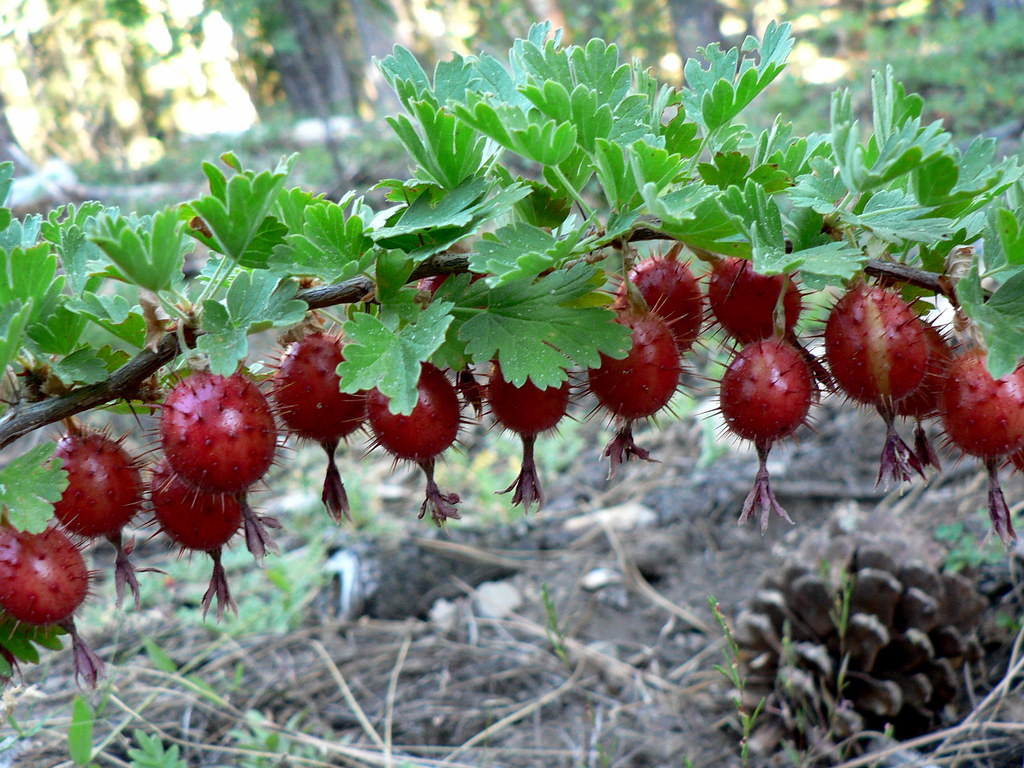
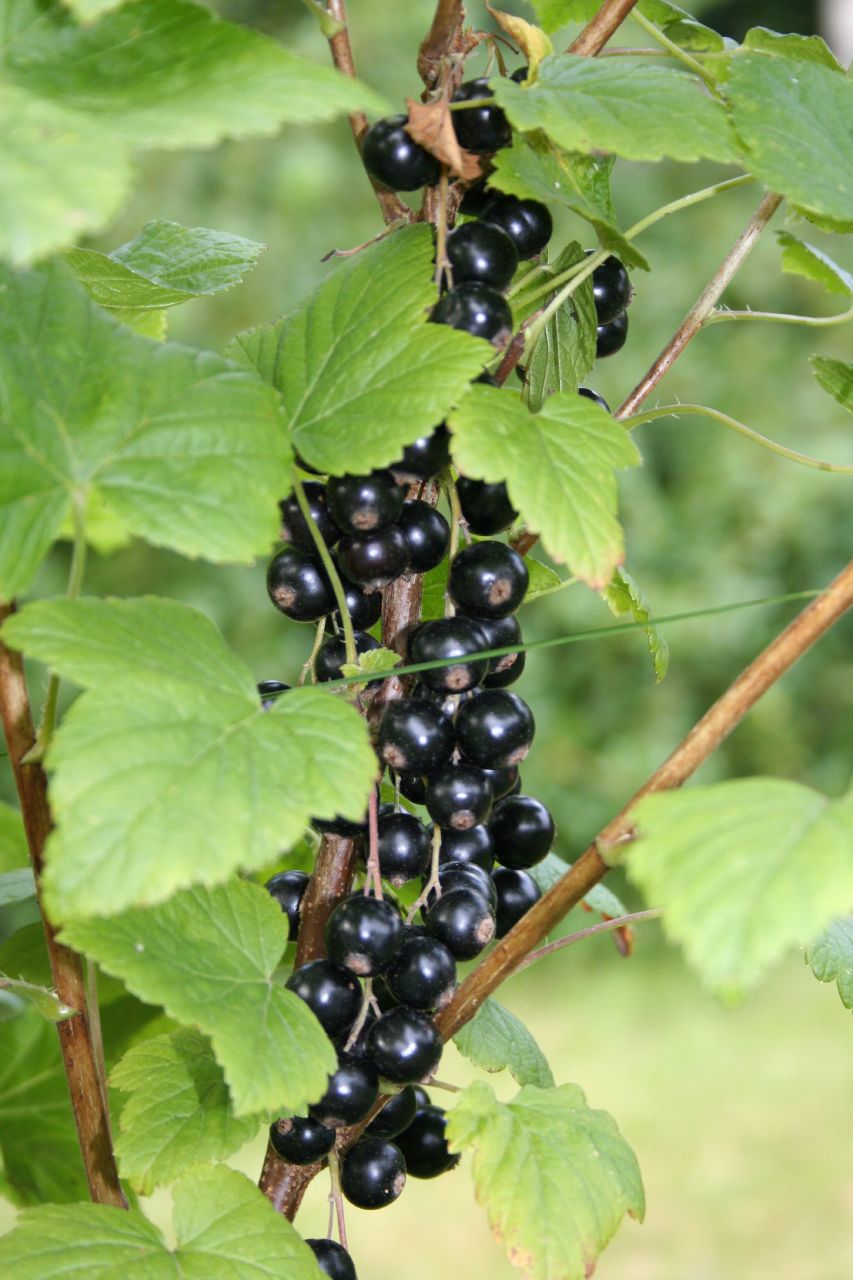
Ribes is a large genus; we have 14 species that are common throughout Montana.  The shrubs grow from three to over nine feet tall, spreading into a thicket through zealous new sprouts that spring from the roots.  The berries are prolific, ranging from shades of yellow, orange, and red to a purplish-black.  In general, gooseberries have prickles and currants do not.  Common names being fickle as they are, however, this is not always the case.
Cooking spiny gooseberries softens the thorns and makes them palatable.

Range:
Ribes are native to high latitudes of the northern hemisphere, and can be found in every Canadian province and US state except Louisiana and Hawaii.  Europe and Asia also host several native species.  Click here to see distribution maps of different species. 

What's in a Name?
Over 2000 years ago, the Greek city Corinthe began growing and shipping a small dried grape (Uva corinthiaca) all over Europe.  The word "currant" is a corruption of "Corinthe"; it was incorrectly assumed that these Corinthian grapes were actually Ribes berries.  The misnomer stuck.  Ribes, in turn, derives from the Arabic or Persian word ribas, "acid-tasting".  The root of the family name, Grossularia, is a Latinization of the French word for currant, groseille.  And gooseberries, well...they just taste good when they're stuffed into a roast goose, according to old English custom.   

 Tidbits:  It comes as no surprise that this useful berry has such a long and vivid history.  North American tribes used currants and gooseberries for summer and winter sustenance, as treatment for ailments ranging from toothaches to kidney disease to snakebites, and as a seasonal signal for when to plow and plant corn.  Gooseberry thorns were used to remove splinters and apply tattoos.  It was believed that Ribes growing alongside streams was an indicator of fish, and that sprigs of the plant placed in cribs kept babies happy. Lewis and Clark were delighted with the three species of Ribes they discovered on their travels along the Missouri River:
         wax currant (R. cereum)
         sticky currant (R. viscosissimum)
         and golden currant (R. aureum).

Golden currant is perhaps the most well-known and widespread.  Today, currants are generally thought of as a tasty berry.  Indeed, all Ribes fruits are edible, but they can be sweetly juicy, puckery tart, dry and seedy, or just plain weird tasting.
Currants are host to the first stage of blister rust (Cronartium ribicola), a fungus that's harmless to Ribes but deadly to five-needled pines.  Blister rust was introduced to the US from Europe around 1900, and through the 1950s there was a massive (unsuccessful) Ribes eradication effort which included a ban on commercial production.  Today, currants are only produced commercially in Greece and South Africa.

Wild gardening:
Ribes offer early spring flowers (April-May), bright summer berries and bold fall colors.  They're easily propagated by their offshoots, which can be tugged out of the ground, snipped off along with some stringy roots and popped in the ground as is.
As with all new plantings, give them plenty of water the first season to establish a healthy root system, and within three years they'll start bearing fruit.  They are happy in sand or clay, sun or part shade, standing water or drought.  Trim suckers diligently to keep a tidy, compact shrub, or allow to naturalize into a thicket haven for wildlife.  Here at the Nature Adventure Teaching Garden at Fort Missoula, Golden Currant fills out a native bed, along with Western Yarrow (Achillea millefolium), Prairie Junegrass (Koelaria macrantha) and Big Sagebrush (Artemisia tridentata).
Currants fill an important niche by providing an early-season nectar source for bees and hummingbirds, particularly the Rufous and Calliope in western Montana.  For more info on nontraditional pollinator plants, check out this excellent article from Montana Wildlife Gardener  The berries are a source of food for birds, black bears and rodents, while the abundant leaves are an important browse for deer and elk in the wild.