Showing posts with label Spring flowers. Show all posts

December 29, 2016

Wild Geranium

Sticky Geranium
Geranium viscosissimum
Geraniaceae

Quick ID
This perennial herb rises 1-3 feet up from thick, meaty rhizomes at the ground, with stem nodes swollen like arthritic knuckles.  Two-inch flowers are scattered atop, often nodding tipsy above the leaves, their five round petals ranging from gentle pink to an earnest fuchsia.  In time the blossoms give way to fruit capsules, their styles elongating into a distinctly pointed 1-inch 'beak' that eventually splits open, catapulting the seeds out and away from the plant.  Pow! Genius.  Leaves are palmate, with 5-7 toothy lobes divided almost to the base, arranged opposite along the flower stem and then alternating below.  The bracts (below the flowers), upper stems and leaves are glandular and sticky.  We wouldn't go so far as to say "gooey"...they feel more like they've been sprayed with an aerosol adhesive and never dried.  

There are seven Geranium species in Montana, the most similar being G. richardsonii, the White Geranium, whose flowers are...white.  But before you get too comfy boasting your botanical prowess, remember that this genus is notoriously difficult to label.  If you're picky-picky (I am not) check out SW Colorado Wildflowers' awesome article on the nitty-gritty details of telling geranium species apart, along with other interesting taxonomic morsels.

Range
Found commonly in foothills to montane, from south-central BC and Alberta to Colorado, Utah and Nevada.  Like me, this species is not picky, and will be found in forests and prairies and open meadows, dry or soggy, shaded or in full reach of the sun.

What's in a Name?
In 1753, Linnaeus chose the genus name Geranium from the classical Greek word for a crane, geranos, in reference to the long beak-shaped fruits of late summer...today you'll often hear geraniums called "cranesbill" or "storksbill,"  The species name viscosissimum points to this species' sticky leaves and stems.  Viscum is the late Latin name for birdlime (a sticky goo spread on twigs to trap little birds) and ultimately comes from the ancient root weis-, meaning to melt or flow away.
Incidentally, the good old All-American Geranium we know and love (or loathe, depending on our moods), stocked so liberally in garden centers and windowboxes across the country, is not a geranium at all but rather a Pelargonium, evergreen and native to the tropics.   

Tidbits
Still going strong, first week of November
Sticky geraniums have a luxuriously long bloom time, opening blossoms dependably from May to August (depending on elevation of course).  This past fall (2016) was delightfully long and warm in central Montana, extending the blooming season clear into November.
As with most of our native species, the plant has a lengthy list of long-ranging medicinal uses.  It's edible but astringent and reportedly "unappealing".  We also need to take care not to confuse geraniums with monkshood (Aconitum columbianum), whose leaves are very similar and very poisonous.
         And finally...are geraniums carnivores?  May well be.  You'll certainly find wispy little bugs stuck on them, and to me that's an indicator that at least something's going on.  And some 20 years ago, a certain G. G Spomer's studies pointed to the fact that G. viscosissimum produces an enzyme capable of breaking down and digesting proteins.  As with everything, the question begs more study, but if you're interested you can check out his piece and see for yourself (Spomer, G.G. (1999). Evidence of protocarnivorous capabilities in Geranium viscosissimum and Potentilla arguta and other sticky plants. International Journal of Plant Sciences, 160(1): 98-101).

Wild Gardening
This is an excellent choice for native landscaping, as it's tolerant to a wide range of conditions and quick to produce blooms.  It's relatively easy to grow from seeds using a cold moist stratification method, but remember that the ripe fruits actively toss their seeds onward and outward, so collection can be tricky.  On the other hand, vegetative propagation through cuttings and rhizome divisions is a snap in the spring.  Give them dappled shade and not much water, and sit back ready to watch the pollinators come running.  Sticky geraniums are a great venue to observe all kinds of fascinating insect species...bees and beetles and butterflies all love them.  The petals are lined with dark-hued stripes that reflect ultra-violet light and guide insect towards the nectar source. Here, a scarab beetle that's evolved to mimic a bumblebee poses happily for a photo.  The resemblance is striking, but you can't fool me!  


April 20, 2014

Pasqueflower

Pasqueflower
Pulsatilla patens
Ranunculaceae (Buttercup Family)


Quick ID
Look for tufts of silky leaves growing from a perennial root crown, about 6" tall.  The leaves are divided into wispy leaflets, generally in threes.  The silver dollar sized flowers lack petals; what a "normal" person would call the petals are technically sepals, forming a cup-shaped calyx around a cluster of waggly yellow stamens.  (Calyx is what the sepals are called collectively.  If they were petals, it would be called a corolla.  Botany, boom.)
Flowers, which come up before the leaves, are shades of purple, from deep mauve to pale lavender.  They have silvery hairs on the outside, with smooth, lighter colored inner surfaces.  Although you might find a rare white P. patens, it's more likely what you're seeing is the western pasqueflower, P. occidentalis, or one of the Anemone species.

The flowers poke upright when they're new, then hang down like a bell as they mature, and finally give way to little smokebombs of tufted hairs as they set fruit.


Range
P. patens is found in the boreal zone (45°-65° latitude) all around the northern hemisphere.  It's fairly common in the the western region of North America, from Alaska down to New Mexico.  The pasqueflower prefers drier places than many of its Ranunculaceae cousins.  Look for it in grasslands or open rocky (often south-facing) slopes, in steppe to subalpine zones. (Side note.  Steppe communities are basically grassland prairies and plains, where the only trees found are the ones growing by water, and the subalpine region is found just below the treeline.  The elevation of these zones can vary dramatically based on where you are in the world.)


What's in a Name?
"Pasque" is from the original Latin word for Easter, Pascha.  You can usually find these flowers blooming around the Easter holiday...oftentimes before the snow is even off the ground.  The species name patens means "spreading," and is one you see a lot in the plant world.  Pulsatilla is derived from the Latin pulso, meaning battered or beaten.  This might be because the flowers, top-heavy on their delicate stems, bob around and seem battered by the wind.

This segues nicely into a quick chat about anemones.  Most (but not all) sources agree that anemones were named for the Greek anemos, "wind," hence the common name of windflower.  Maybe, as some say, it's because the flowers only open when they're beaten by the wind, or on the other hand, won't open if the wind is blowing.
Maybe the Greek wind gods, the Anemoi, use these flowers to herald their arrival in spring.  Or maybe (and this is the one I like to believe) they're windflowers because their seeds are so obviously and perfectly adapted for wind dispersal.  Their tiny nut-like achenes (a one-seeded fruit) sport feathery plumes that just beg to be blown and tumbled across an open prairie.  Pulsatilla patens shares pretty much all characteristics with those of Anemone, except the hairy tails of their fruits are long like a kite.  Indeed, pasqueflower is often cited as Anemone patens.  

Common names for this plant can be confusing.  It's sometimes called prairie smoke (in reference to the hairy fruits), although this is more widely accepted as the common name for Geum triflorum.  Many sources list it as prairie crocus, although the garden-variety crocus we all know and love is actually in the iris family.  It's also known as the Easter flower, May Day flower, cutleaf anemone, and probably a host of other regional names.  

Tidbits
As with all of the Ranunculaceae crew, the pasqueflower contains poisonous compounds that can make you really sick, causing nausea, dizziness and a drop in blood pressure.  And as with pretty much all poisonous plants, there are numerous accounts of people using it medicinally to treat an array of ailments.  Here's what Montana Plant Life has to say...
Use of pasqueflower reportedly lessens sexual excitement. It does not diminish sexual power but rather strengthens it by lessening excitement. A drug derived from the chopped whole plant induces vomiting and irritation of the kidneys. In high doses it acts as a depressant on the central nervous system and the heart. A decoction of the plant was used by the Blackfoot Indians to speed delivery of a child.
Yeesh.  As always, proceed with caution.  Plants are crazy dangerous.  Durr.
I did think it was interesting, however, to find so many references to using mashed pasqueflower leaves as a "counter-irritant" for bruises, sore muscles and rheumatic joints.  Is this like when you have a toothache and someone offers to stomp on your foot to distract you from the pain?  Must be!  I do know these leaves are covered in little hairs, and handling them too much can be really irritating to sensitive skin.
Being a common plains wildflower, the toxins in pasqueflower can be a problem for domestic grazing animals.  I've also read that dense stands of pasqueflower is an indication that the land has been overgrazed, but can't find any decent explanation as to why this is.  Are they pioneer species, the first to colonize the disrupted ecosystem, or are they just growing in abundance because grazers selectively avoid them?
I did find some interesting reading on the decline of P. patens populations in boreal forests due to decreased grazing and increased fire suppression.  As domestic grazing declines and normal forest fire cycles are disrupted, the vegetation undergrowth gets thicker and more closed-in.  This has a pretty drastic effect on many species in the boreal ecosystem, especially those that grow in open sites with relatively small amounts of forest litter. 

Wild Gardening
By all means!  Seeds are easy to collect and don't require cold stratification, although the Native Plant Network does recommend a 60 day cold spell.  You can also divide clumps or take root cuttings in spring or late fall.  Keep them in the sun, in fairly dry soil, and know that plants might go dormant in drought conditions.  The flowers are lovely, and the feathery leaves last well into the summer.  Being such an early bloomer, pasqueflowers provide crucial nectar reserves for early emerging wild bee pollinators.  Try some in your rock garden!  Send me pictures.

March 15, 2014

Welcome back, Spring!

Happy Ides of March, everyone!  I'm back after a solid winter break, and pretty excited to be packing away my long undies and sharpening up my garden tools.  It's been a badass winter...
Here's my back yard, June 1st a couple years ago versus March 1st this year.  All that snow is from one day, btw, and is well over ten feet high.  It was an excellent blizzard, and after a day of subzero temps and howling yowling winds, the weather is pretty much back to normal for this time of year.  Sunny skies mixed with some drizzly rainshowers, and temps in the glorious mid-50s.
A hike on Waterworks Hill yesterday told me that the bitterroots are out in droves.  I found hundreds of the bright green anemones tucked into the rocky northeast slopes.  Now I'll start keeping my eyes peeled for buttercups, draba and Rocky Mountain douglasia.  The earliest spring wildflowers are some of my favorites.
Draba verna, each flower no bigger than a grain of rice.
I'm starting up a new project with Watershed Consulting, hunting for Mecinus janthinus, the biocontrol weevil that attacks the noxious weed toadflax.  The hard cold temperatures this winter (we had two good stretches where it was under 20 below zero) killed off quite a few bugs, which overwinter as adults in the toadflax stems.  Our plan is to find stems that were hidden underneath the snow during those cold snaps.  Hopefully the snow will have provided some protection from the frigid temps, much like an insulating blanket.  We'll see!  Once we find the weevils, we'll pack some of the population up and ship them out. The simple version of how biocontrol projects like this work is this:
Linaria dalmatica, Dalmation Toadflax
A non-native plant moves into an area where it has no natural predators, nothing to check its growth.  In some cases, this exotic plant turns out to be such a good competitor that it starts displacing the native plants of the area, which in turn has a devastating ripple effect on the local ecosystem.  The plants that have really really bad environmental and economic effects get deemed official "noxious weeds," and are thereafter subject to some government regulations.  One of the ways we try to control these noxious invaders is through the use of biocontrols...in other words, introducing predators that will attack the weeds and slow their population growth.  Like a weevil, that eats toadflax.  It's a long, somewhat complicated process (you can imagine the risks involved in introducing another exotic species into the environment) but in the end, biocontrol agents really do work as a weed management tool.  So we introduce the bugs, let their population build up to a healthy level, then collect some and ship them to other parts of the state that have the weed but not yet the weevil.  And so on and so forth.  
Matt, from my 2013 Youth in Restoration crew, getting biocontrol weevils ready to ship.
It's a fascinating and effective process, and one that I'm really excited to learn more about.  Over the next few weeks, you'll find me out in the hills, rambling through weedy patches, slicing stems and looking for Messinus.  Did they survive more on north or south slopes?  Low or high?  Big stems or small?  The Bitterroot Valley or the Swan?  So many questions.  I'll let you know how it goes.
In other news, I'm still building wild bee houses, and now is the season to order one!  You can visit my Flora montana Etsy shop, or pop in to one of the Missoula businesses that carry them (the Naturalist's Mercantile and The Buttercup Market and Cafe, at the moment).  I have woodblock photography and bee houses on display (and for sale!) at the Montana Natural History Center through the end of April, and will be setting some stuff up at Bad Goat for a First Friday show in May.  And of course, feel free to drop me a line if you'd like to order one directly from me!  I'd love to hear from you.  Happy spring, everyone.  I'll be back soon with the first of this season's Plant Profiles.  Keep in touch.

May 27, 2013

Arrowleaf Balsamroot

Arrowleaf Balsamroot
Balsamorhiza sagittata
Asteraceae (Sunflower family)

Quick ID
In late spring, arrowleaf balsamroot covers open hillsides in an unmistakable blanket of golden, sunflower-like flowers.  The fuzzy, silvery-green leaves can be 6" wide and over 12" long, arising from from the base of the plant in tufts like bunchgrasses.  Flowers bloom May-July, and are borne singly on stalks that can get 3' tall.
Flowers like these are known as "composites" and are actually made up of two different types of inflorescence.  Tiny tubular disc flowers cluster together to form the central eye, while the "petals" are actually a ring of ray flowers.  Some species in the Asteraceae family have only ray flowers (like dandelion), some have only disc flowers (like rabbitbrush) and some have both together!
Range
Native to western North America, you can find arrowleaf balsamroot growing in meadows, sagebrush steppe and conifer forest openings at low elevations (most commonly 3500-7000') as far east as the Dakotas, south to Arizona and north at least to BC and Alberta.

What's in a Name?
Nice and straightforward.  The leaves are shaped like arrows.  Sagittata comes from the Latin word for arrow, "sagitta".  Balsamorhiza is named for the large woody taproot, which produces a thick sap that smells like balsam fir.  "Balsam" basically indicates any nice-smelling plant, and rhiza is the Latin word for root.

Tidbits
Did you know that arrowleaf balsamroot, with its cheery flowers up to 4" wide, is our biggest wildflower here in Montana?  And such an important species in western landscapes.  Balsamroot is rich in protein, providing excellent graze for deer, elk, bighorn sheep and pronghorn.  The nutritious oily seeds are important to birds and rodents, and the open-faced flowers are perfect for native pollinators.  Every part of the balsamroot plant is edible, and has been used as food and medicine across its native range for thousands of years.  The massive taproot, which can be eight feet deep and as wide as your hand, makes it especially well-equipped to withstand fire, grazing, weeds and drought.  I love looking up at a hillside blooming in full force, picturing the massive roots drilling into the earth deeper than I am tall, opening tunnels for underground excavators, lending a foothold to the sloping soil, casting about for that fleeting sip of moisture.  If I had x-ray eyes, I have a feeling I'd keep them trained downward.
Lewis & Clark's Corps of Discovery collected arrowleaf balsamroot near present-day Lincoln, MT, in July 1806.  Their specimen sheets, prepared by the fascinating botanist Frederick Pursh, are still housed at the Lewis & Clark herbarium in Philadelphia.

Wild Gardening
As a tremendously showy, long-lived specimen plant that can withstand nature's brutality with the best of us, arrowleaf balsamroot should be a wild gardener's dream.  This is not, however, a species for the weak-willed or fickle-hearted.  Balsamroot requires steadfast determination and cooperation.  The massive taproot makes transplanting nearly impossible.  They can be grown from seed, but like many of our native wildflowers, they need to go through cold stratification.  No worries though; this isn't as technical as it sounds.
My personal wild gardening strategy is based on equal parts logic and ease: just watch what the wildflowers are doing, and copy them.  If the balsamroot at my elevation is dropping seed in mid-July, my own planting won't be far behind.  I'll put extra seed down, figuring some will get carried off by insects and other critters, and many just won't take at all.  The winter weather will naturally take care of the required cold stratification, and when temperatures warm up, the seeds will sprout when they're good and ready.  I'll be patient, knowing that even in perfect conditions, it will take five years for my seedlings to flower.  But when they do...ohhh baby.  My happy little bees are bound to buzz right up and kiss me on the nose.

April 22, 2013

Currants and Gooseberries

Currants & Gooseberries
Ribes spp.
Grossulariaceae (Currant Family)
Quick ID:  
The many species of Ribes have a few things in common.  Look for deciduous shrubs with alternate, palmately lobed leaves growing along streams and on drier foothills.  The spicy-scented flowers can be white, pinkish or yellow, with petals fused into a tube at the base.  The ovaries are inferior-somewhat more rare in the plant kingdom than superior ovaries.  This basically means that the female part of the flower (that, once pollinated, will swell into a seed-bearing fruit) is located below where the petals and sepals are attached.  
Incidentally, inferior ovaries evolved later in plants; a protective measure to keep the important reproductive parts tucked away.  It's easy to see once the fruit starts forming, with the end result being a dry little spike where the flower once was, right at the end of the berry.
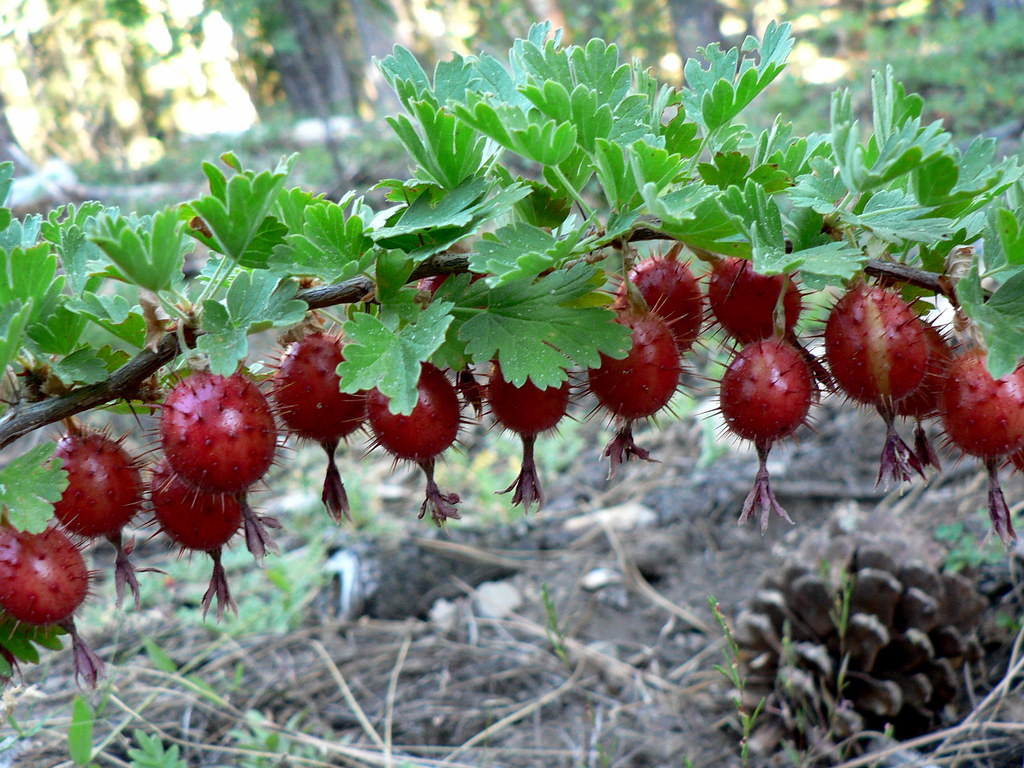
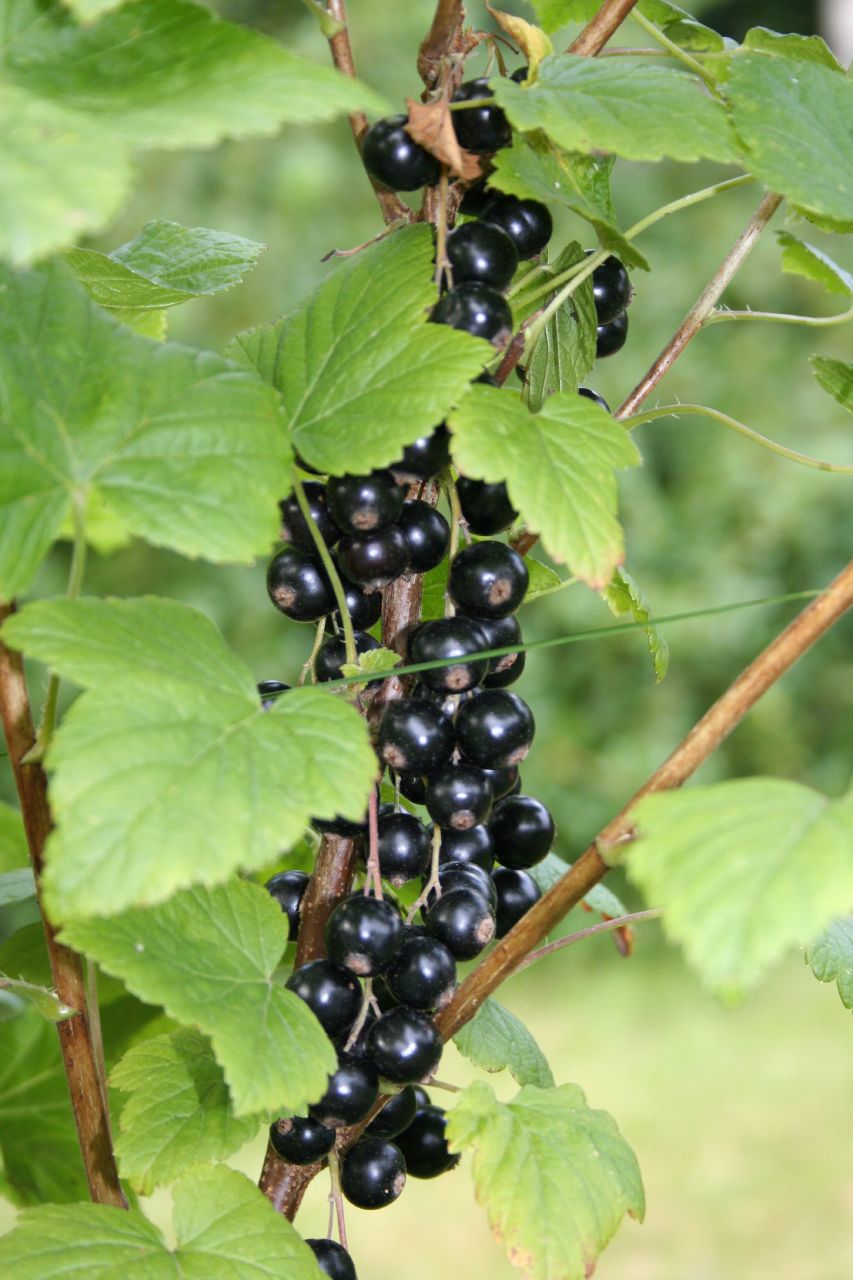
Ribes is a large genus; we have 14 species that are common throughout Montana.  The shrubs grow from three to over nine feet tall, spreading into a thicket through zealous new sprouts that spring from the roots.  The berries are prolific, ranging from shades of yellow, orange, and red to a purplish-black.  In general, gooseberries have prickles and currants do not.  Common names being fickle as they are, however, this is not always the case.
Cooking spiny gooseberries softens the thorns and makes them palatable.

Range:
Ribes are native to high latitudes of the northern hemisphere, and can be found in every Canadian province and US state except Louisiana and Hawaii.  Europe and Asia also host several native species.  Click here to see distribution maps of different species. 

What's in a Name?
Over 2000 years ago, the Greek city Corinthe began growing and shipping a small dried grape (Uva corinthiaca) all over Europe.  The word "currant" is a corruption of "Corinthe"; it was incorrectly assumed that these Corinthian grapes were actually Ribes berries.  The misnomer stuck.  Ribes, in turn, derives from the Arabic or Persian word ribas, "acid-tasting".  The root of the family name, Grossularia, is a Latinization of the French word for currant, groseille.  And gooseberries, well...they just taste good when they're stuffed into a roast goose, according to old English custom.   

 Tidbits:  It comes as no surprise that this useful berry has such a long and vivid history.  North American tribes used currants and gooseberries for summer and winter sustenance, as treatment for ailments ranging from toothaches to kidney disease to snakebites, and as a seasonal signal for when to plow and plant corn.  Gooseberry thorns were used to remove splinters and apply tattoos.  It was believed that Ribes growing alongside streams was an indicator of fish, and that sprigs of the plant placed in cribs kept babies happy. Lewis and Clark were delighted with the three species of Ribes they discovered on their travels along the Missouri River:
         wax currant (R. cereum)
         sticky currant (R. viscosissimum)
         and golden currant (R. aureum).

Golden currant is perhaps the most well-known and widespread.  Today, currants are generally thought of as a tasty berry.  Indeed, all Ribes fruits are edible, but they can be sweetly juicy, puckery tart, dry and seedy, or just plain weird tasting.
Currants are host to the first stage of blister rust (Cronartium ribicola), a fungus that's harmless to Ribes but deadly to five-needled pines.  Blister rust was introduced to the US from Europe around 1900, and through the 1950s there was a massive (unsuccessful) Ribes eradication effort which included a ban on commercial production.  Today, currants are only produced commercially in Greece and South Africa.

Wild gardening:
Ribes offer early spring flowers (April-May), bright summer berries and bold fall colors.  They're easily propagated by their offshoots, which can be tugged out of the ground, snipped off along with some stringy roots and popped in the ground as is.
As with all new plantings, give them plenty of water the first season to establish a healthy root system, and within three years they'll start bearing fruit.  They are happy in sand or clay, sun or part shade, standing water or drought.  Trim suckers diligently to keep a tidy, compact shrub, or allow to naturalize into a thicket haven for wildlife.  Here at the Nature Adventure Teaching Garden at Fort Missoula, Golden Currant fills out a native bed, along with Western Yarrow (Achillea millefolium), Prairie Junegrass (Koelaria macrantha) and Big Sagebrush (Artemisia tridentata).
Currants fill an important niche by providing an early-season nectar source for bees and hummingbirds, particularly the Rufous and Calliope in western Montana.  For more info on nontraditional pollinator plants, check out this excellent article from Montana Wildlife Gardener  The berries are a source of food for birds, black bears and rodents, while the abundant leaves are an important browse for deer and elk in the wild.  

April 14, 2013

Blue-eyed Mary


Blue-eyed Mary
Collinsia parviflora
Scrophulariaceae (Figwort Family)

Quick ID:  
The hard part isn't being able to identify Collinsia, but being able to spot it in the first place. The flowers are tiny, rarely more than a few millimeters across.  Luckily they're often found growing in groups, on relatively bare ground.  Look for little snapdragony-type flowers growing on red, hairy stems with narrow linear leaves.  The entire plant is just a wisp, really, and a mass of them blanketing the ground is a real springtime delight.
Delightful though they may be, they are also notoriously hard to photograph.  Here, Blue-eyed Marys dot the foreground along with Larkspur, Shooting Star, Biscuitroot and Woodland Star.  Kootenai Creek tumbles below the hillside.

Range:
You'll find Collinsia in moist, shady forests, often growing where other plants are sparse, and on sunny slopes early in the season.  Its large range extends throughout the southern parts of Canada, south to Texas and east to Colorado.  In Montana, it's mostly found in the southern and western parts of the state.

What's in a Name?
Who is this Mary lady?  There have been a few rather famous Marys throughout history (it was the #1 most common name in 1900, and still remained there as of 1990), so I guess the mystery isn't quite as intriguing as if the plant was called...say, Blue-eyed Leah, but still.  It seems the origin of this particular moniker is lost to us; I certainly can't find any mention of it.
Scientific names are much easier to track down.  Collinsia is named in honor of Zaccheus Collins, VP of the Philadelphia Academy of Natural Sciences around the turn of the 19th century.  Thomas Nuttall named the genus after him, and David Douglas named the species in 1827.  The Latin word parvus means small-in this case, small flowers (parviflora).  There are 19 species of Collinsia, including one with "giant" flowers, aptly named C. grandiflora.
Now, I've read that members of the Scrophulariaceae family (scrophs, we call them) are named for scrofula, which they're supposed to cure.  Scrofula is an archaic word for certain kinds of tuberculosis, which are spread through unpasteurized milk (the Latin scrofule meaning "brood cow").  But according to Borrors awesome Dictionary of Root Words and Combining Forms, scrophul- means a tumor or glandular swelling.  And lo and behold, scrophs have also been used to treat hemorrhoids...which in the olden days were known as "figs" --hence the common name "figwort family" (wort generally meaning "a plant"). 
!!! Crazy stuff, I tell ya what.   

Tidbits:  Other Scrophs include penstemon, snapdragons, paintbrush, foxglove and monkeyflower.  All have characteristic corollas (petal arrangements) with upper and lower "lips".  In Collinsia, the upper lip is usually lighter than the dark blue lower lip.
There are brief mentions of Blue-eyed Mary being used by the Kayenta Navajo as a "plant to make horses run fast", and Ute tribes used it externally on sore flesh.
Wild gardening:
Collinsia is one of those sought-after plants that enjoys shade and can tolerate shallow soil.  It also has a long bloom season (Apr-July) and will establish and spread easily if there's not too much competition from surrounding plants.
This is an annual plant; it grows from seed produced the previous season rather than surviving by underground storage structures.  You can start collecting seeds (a somewhat tedious endeavor) in late May, and sow them outdoors in the fall.
This is a great example of how wild gardening conveniently mimics natural systems.  Plants drop their seeds in the fall, and wait for spring moisture and temps to be right for germination.  You can do the same thing.  It takes the guesswork out of the equation, and the plants will thank you for it.  Come spring, you can sit back and enjoy the show.