Showing posts with label Insects. Show all posts

December 29, 2016

Wild Geranium

Sticky Geranium
Geranium viscosissimum
Geraniaceae

Quick ID
This perennial herb rises 1-3 feet up from thick, meaty rhizomes at the ground, with stem nodes swollen like arthritic knuckles.  Two-inch flowers are scattered atop, often nodding tipsy above the leaves, their five round petals ranging from gentle pink to an earnest fuchsia.  In time the blossoms give way to fruit capsules, their styles elongating into a distinctly pointed 1-inch 'beak' that eventually splits open, catapulting the seeds out and away from the plant.  Pow! Genius.  Leaves are palmate, with 5-7 toothy lobes divided almost to the base, arranged opposite along the flower stem and then alternating below.  The bracts (below the flowers), upper stems and leaves are glandular and sticky.  We wouldn't go so far as to say "gooey"...they feel more like they've been sprayed with an aerosol adhesive and never dried.  

There are seven Geranium species in Montana, the most similar being G. richardsonii, the White Geranium, whose flowers are...white.  But before you get too comfy boasting your botanical prowess, remember that this genus is notoriously difficult to label.  If you're picky-picky (I am not) check out SW Colorado Wildflowers' awesome article on the nitty-gritty details of telling geranium species apart, along with other interesting taxonomic morsels.

Range
Found commonly in foothills to montane, from south-central BC and Alberta to Colorado, Utah and Nevada.  Like me, this species is not picky, and will be found in forests and prairies and open meadows, dry or soggy, shaded or in full reach of the sun.

What's in a Name?
In 1753, Linnaeus chose the genus name Geranium from the classical Greek word for a crane, geranos, in reference to the long beak-shaped fruits of late summer...today you'll often hear geraniums called "cranesbill" or "storksbill,"  The species name viscosissimum points to this species' sticky leaves and stems.  Viscum is the late Latin name for birdlime (a sticky goo spread on twigs to trap little birds) and ultimately comes from the ancient root weis-, meaning to melt or flow away.
Incidentally, the good old All-American Geranium we know and love (or loathe, depending on our moods), stocked so liberally in garden centers and windowboxes across the country, is not a geranium at all but rather a Pelargonium, evergreen and native to the tropics.   

Tidbits
Still going strong, first week of November
Sticky geraniums have a luxuriously long bloom time, opening blossoms dependably from May to August (depending on elevation of course).  This past fall (2016) was delightfully long and warm in central Montana, extending the blooming season clear into November.
As with most of our native species, the plant has a lengthy list of long-ranging medicinal uses.  It's edible but astringent and reportedly "unappealing".  We also need to take care not to confuse geraniums with monkshood (Aconitum columbianum), whose leaves are very similar and very poisonous.
         And finally...are geraniums carnivores?  May well be.  You'll certainly find wispy little bugs stuck on them, and to me that's an indicator that at least something's going on.  And some 20 years ago, a certain G. G Spomer's studies pointed to the fact that G. viscosissimum produces an enzyme capable of breaking down and digesting proteins.  As with everything, the question begs more study, but if you're interested you can check out his piece and see for yourself (Spomer, G.G. (1999). Evidence of protocarnivorous capabilities in Geranium viscosissimum and Potentilla arguta and other sticky plants. International Journal of Plant Sciences, 160(1): 98-101).

Wild Gardening
This is an excellent choice for native landscaping, as it's tolerant to a wide range of conditions and quick to produce blooms.  It's relatively easy to grow from seeds using a cold moist stratification method, but remember that the ripe fruits actively toss their seeds onward and outward, so collection can be tricky.  On the other hand, vegetative propagation through cuttings and rhizome divisions is a snap in the spring.  Give them dappled shade and not much water, and sit back ready to watch the pollinators come running.  Sticky geraniums are a great venue to observe all kinds of fascinating insect species...bees and beetles and butterflies all love them.  The petals are lined with dark-hued stripes that reflect ultra-violet light and guide insect towards the nectar source. Here, a scarab beetle that's evolved to mimic a bumblebee poses happily for a photo.  The resemblance is striking, but you can't fool me!  


August 5, 2016

Paintbrush

Paintbrush
Castilleja sp.
Orobanchaceae (Broomrape Family)


Quick ID
Castilleja blooms in early summer in a wild assortment of reds, oranges, pinks, yellows, even purples.  The colorfully painted brush atop each plant is not actually the flower, but rather the plant's leafy bracts that gradiate to green towards the base.  The actual flowers at the tips of these petal-like leaves are not much to speak of.  Paintbrush tends to be a moderately sized perennial herb, upright and with a woolly quality.  The narrow leaves  are alternately arranged, without stalks, clustered along a stem that can get woody at its base.  Castilleja could easily be confused with the closely related owl clover (Orthocarpus) or even the not-closely related Liatris, if one isn't careful.

Liatris (right) and owl clover above...both native, neither one a paintbrush!
At any rate, the species can be exceedingly difficult to tell apart, as they hybridize easily.  Even the most authoritative taxonomists in the business use caution with this genus.

Range
Around 200 species of Castilleja evolved in the Americas and northern Asia.  Most of the diversity is found in the Northwest region of the US and Canada, although species range down to the Andes.  Plants grow in a wide range of ecosystems. Look for them in forest meadows, rarely in dense stands but instead sprinkled in among other wildflower communities.

What's in a Name?
One used to commonly hear this plant called Indian paintbrush (although most gardeners and botanists I know have come to find the term distasteful) or prairie-fire. The genus name Castilleja was first published in Carolus (the younger) Linnaeus's Supplementum Plantarum in 1782, after Professor of Botany Domingo Castillejo of Cadiz, Spain.  The name was chosen by Jose Celestino Mutis, a world-class botanist in his own right, who must have been one of Castillejo's admirers.  The surname, incidentally, means "little castle".

Around 2001, the botanical family Scrophulariaceae started to get a major makeover.  To put it simply, improved research methods started revealing that as far as genetic relationships are concerned, way too many plants were being included in the family.  So taxonomists kicked a whole bunch of genera out of the group, squeezing them in with Orobanchaceae, Plantaginaceae and some other families.  This sort of taxonomic restructuring can get really technical...and really messy.  Take, for example, the Wiki entry on Scrophulariaceae (which, admittedly, has always been something of a mishmash family) :
Fischer (2004) considered the family to consist of three subfamilies; AntirrhinoideaeGratioloideae, and Digitalidoideae. He further divided the Gratioloideae into five tribes; GratioleaeAngeloniaeaeStemodieaeLimoselleae and Lindernieae. He then divided the Gratioleae, with its sixteen genera (and about 182 species) into three subtribes; CaprarinaeDopatrinae and Gratiolinae. The Gratiolinae had ten genera (about 121 species) distributed through temperate and tropical America; Bacopa and Mecardonia (formerly Herpestis), Amphianthus,GratiolaSophronanthe,  BenjaminiaScopariaBoelkeaMaeviella and Braunblequetia. Many of these were transferred to the family Plantaginaceae, in the tribe Gratioleae.
 Yikes!  While some folks, bless their hearts, really get excited with this level of nit-picky detail, the rest of us are left throwing our forever-outdated field guides up in the air, exasperated.   What's cool about the binomial nomenclature system (Genus species) is that everybody all over the world can use the same name for an organism, no matter what language you speak or what region you hail from.  Nice and simple.  All the new (yes yes, more accurate) swip-swapping of names can get complicated, and intimidating for the budding botanist.
At any rate Castilleja, formerly a scroph, is now in the Orobanchaceae (Broomrape) family.  This actually does make sense, as the broomrapes, like paintbrush, are largely parasitic plants.


Tidbits

Castilleja is what's known as a hemiparasite.  Unlike true parasitic plants, it has the chlorophyll to photosynthesize on its own.  It can even live on its own, but will be stunted and miserable.  It would much prefer to worm its haustoria (special roots for plants looking to borrow a bit from their neighbor) into their host plant's root system and pick up a little water- and nutrient-boost.  I thought Tracey Switek's post in The Olive Tree explained it really nicely, so give it a look-see to learn more about paintbrush's fascinating parasitism.

And before you cast it aside as a thieving rascal, take heart in the benefits the paintbrush brings to its environment.  Besides the utterly lovely burst of color it provides, this is an excellent pollinator plant, full of nectar and visited by all manner of bees and hummingbirds.  It's also an important larval host for Schinia moths and checkerspot (Euphydryas) butterflies.  The flowers are theoretically edible for people too, and have historically been used to treat various ailments (including love-sickness).  The plant's tendency to accumulate potentially-toxic levels of selenium in the leaves, however, means would-be foragers should go forth with caution.

Wild Gardening
Because paintbrush naturally grows in complex relationship with other plant communities, it's notoriously difficult to cultivate in the garden.  But not impossible!  Collect seed capsules midsummer to fall and dry them in paper bags.  Try giving the seeds a month or so of cold moist stratification...different species will respond to this treatment differently.  You could also try sowing seeds outdoors in fall so they're exposed to naturally fluctuating temperatures.  Start spring seeds in pots or again, try sowing them straight into the ground.  You should see germination within a couple weeks.  A host plant is not required to get seeds to germinate, but your paintbrushes will languish soon without.  Your best bet is to grow it near other native plants that it would be found alongside in nature.  Time to start building that native wildflower meadow you've always wanted!  Good luck!


May 6, 2014

So you want to build a Pollinator Hotel...

Well you can!  And you should.  Pollinator Hotels provide essential habitat for cavity-nesting insects like mason bees and leafcutters, as well as other beneficial critters like spiders, ladybugs, and butterflies.  You'll get to watch this mini-ecosystem unfold in your backyard, observing first hand its life cycles, food chains and day to day goings-on.  Your hotel can be tidy and symmetrical, or thrown together with wild abandon.  You can build them to suit your fancy, changing features and adding on over the years.  And with a little ingenuity and a bit of time spent gathering materials, they're inexpensive and easy to put together.

I build these wild bee houses using salvaged fenceboards and shingles, blue-stain lumber milled from trees killed by bark beetles, and whatever else scraps I can find.  (If you want to buy one, here's my Etsy Shop!)
You can also expand on this idea and install a Pollinator Hotel on-site.  We did this recently as part of the Homestead Hey Day spring celebration at the historic Moon-Randolph Homestead in Missoula.  Volunteers pooled their craftsmanship and creativity, using scrap wood from around the ranch, locally gathered natural materials and hand tools to build a beautiful and functional house for helpful bugs.  We've still got some finishing touches to do, drilling holes in the logs and stuffing crevices with bee tubes, but for one happy afternoon's work, it turned out pretty incredible.  
If you want to build your own you'll want to follow just a few basic guidelines.  Here are some tips to help you get started.

1.  Build a frame
Anything goes, pretty much!  You might want to sketch out a plan before you begin.  How big?  Do you want formal rows of tubes and drilled holes, or rustic compartments of natural materials?  Will it be built on posts, or hanging?  Do you want to stack materials so the hotel can be dismantled and rebuilt easily, or do you want a frame that's held in place by screws...or cement, or...?  Do you want to include spaces to put soil and grow live plants on the structure?  If so, you might want to put them down low so you can water without drenching your insect nesting materials.
Whatever you decide, remember that native bees need one end of their nesting cavity closed.  If you're using completely hollow tubes, you'll want to put a backboard of some sort up.  If you're drilling holes through logs, you can opt to not drill all the way through (for example, drill a 6" deep hole in a 7" deep log).  I personally recommend drilling all the way through and putting up a backboard, however.  That way if you ever decide to clean out your bee holes, it's much easier.


2. Put it in the right place
You'll want to locate your Pollinator Hotel in a place that's at least somewhat shielded from heavy wind and rain.  Face the opening to the south or east so it gets plenty of warm morning sun.  If you live in a really hot sunny location, some afternoon shade in midsummer is helpful too.  Raising the frame off the ground a few feet deters ants, who have been known to sneak in and steal the pollen reserves left for developing larvae.  Just don't put it so high that it's out of insects' normal flight paths.  Somewhere between 4-8' off the ground is ideal.  And make sure the insects have access to a source of food (pollen from trees, shrubs, flowers or vegetables within a couple hundred yards), water and mud, which mason bees use to line their brood cells.  We located ours at the edge of the vegetable garden, facing out towards an ancient orchard.  The early spring flowers of fruit trees are perfect for mason bees (also known as blue orchard bees).  Remember that, once you start to fill in your frame, it will get heavy, so you might want to get it in place beforehand.

3.  Provide nooks and crannies
The idea is to mimic the natural nesting sites of insects in the wild.  This helps mitigate the effects of habitat destruction as native ecosystems give way to concrete, asphalt and (gasp!) turf grass.  So build one for environmental stewardship and conservation!  But also do it for yourself.  Attracting a diverse array of native insects to your yard and garden leads to a healthier ecological balance (thus reducing insect pests), better pollination of your fruits, flowers and veggies, and an awesome opportunity to observe these fascinating creatures up close.
Try to provide a diversity of cracks and crevices to accommodate different nesting habits.  Ladybugs, beetles, lacewings, beneficial spiders, moths and butterflies all seek shelter to raise their young and overwinter, and many native bee species nest in hollow tubes and cavities.  Use different sized sticks, dead flower stalks (sunflowers work great), straw, pine cones, dry grasses and pieces of bark to fill compartments.  Avoid wood that's been treated or recently varnished.
Things are starting to take shape!  Peter cuts plant stalks into tubes, Tyson saws logs, and Natasha slices bark rings to build compartments.

4.  Make the bee holes the right size and depth
Mason bee cells in a milkweed stem
Tubes and drilled holes should be about 6" deep.  This is important.  Nesting mason bees will fill the first ~4" with female eggs, and cap each tube with a couple males.  The eggs hatch into larvae, which pupate into adult bees at the end or the summer.  The males emerge first (presumably to be offered up to any predators lurking outside the nest) followed by the females a couple weeks later.  If your tubes are too short, you risk having all female eggs.  Cavity nesting bees also avoid holes that are too deep, so try not to go over 8" or so.

There are thousands of species of wild bees...all different sizes and with varying preferences.  When drilling holes or cutting tubes, the standard recommended diameter is 3/8".  I've seen bees nest in holes down to 1/8" and as big as 5/8".  I try to provide a variety of sizes, to see what different species I can attract.

Gathering tubes
Finding hollow-stemmed plant materials can be tough.  If you live in an area with bamboo, that works perfect.  I try to use the previous year's dry stalks of Japanese knotweed (an abundant noxious weed), Fuller's teasel (a pain to process, with all the prickles), Queen Anne's lace, milkweed, elderberry, even corn stalks.  Remember that many species have nodes that go all the way through the stem, so these parts need to be cut out or placed towards the back of your hotel.


5.  Protect it
Besides choosing a sheltered location, it helps to put some sort of slanted roof on so rain rolls off.  And if you're worried about birds, squirrels or deer getting into your nesting materials, put some small-gauge chicken wire over the front entrance.

6.  Maintain it over time
If you're using straw, dry grass or other decomposables, clean out the compartment and replace with fresh materials each spring.  In the case of bee cavities, mites and other pests can build up if the tubes aren't cleaned out periodically.  Once every four years or so you'll want to scrape out debris with a poker or replace the tubes entirely.  Some people recommend spraying the holes with a 5-10% bleach solution to kill mites.
Keep an eye on your Pollinator Hotel.  Over time, you'll have an idea of who lives where, what the most popular rooms are, and how well each material and arrangement is working.  Experiment!  Change it up.  Have fun.

If you want to learn more about native pollinators, visit my Wild House of Bees page.  Also check out this excellent compilation of insect habitats from Inspiration Green to see what people around the world are building.  And please, post pictures of what you come up with!

March 15, 2014

Welcome back, Spring!

Happy Ides of March, everyone!  I'm back after a solid winter break, and pretty excited to be packing away my long undies and sharpening up my garden tools.  It's been a badass winter...
Here's my back yard, June 1st a couple years ago versus March 1st this year.  All that snow is from one day, btw, and is well over ten feet high.  It was an excellent blizzard, and after a day of subzero temps and howling yowling winds, the weather is pretty much back to normal for this time of year.  Sunny skies mixed with some drizzly rainshowers, and temps in the glorious mid-50s.
A hike on Waterworks Hill yesterday told me that the bitterroots are out in droves.  I found hundreds of the bright green anemones tucked into the rocky northeast slopes.  Now I'll start keeping my eyes peeled for buttercups, draba and Rocky Mountain douglasia.  The earliest spring wildflowers are some of my favorites.
Draba verna, each flower no bigger than a grain of rice.
I'm starting up a new project with Watershed Consulting, hunting for Mecinus janthinus, the biocontrol weevil that attacks the noxious weed toadflax.  The hard cold temperatures this winter (we had two good stretches where it was under 20 below zero) killed off quite a few bugs, which overwinter as adults in the toadflax stems.  Our plan is to find stems that were hidden underneath the snow during those cold snaps.  Hopefully the snow will have provided some protection from the frigid temps, much like an insulating blanket.  We'll see!  Once we find the weevils, we'll pack some of the population up and ship them out. The simple version of how biocontrol projects like this work is this:
Linaria dalmatica, Dalmation Toadflax
A non-native plant moves into an area where it has no natural predators, nothing to check its growth.  In some cases, this exotic plant turns out to be such a good competitor that it starts displacing the native plants of the area, which in turn has a devastating ripple effect on the local ecosystem.  The plants that have really really bad environmental and economic effects get deemed official "noxious weeds," and are thereafter subject to some government regulations.  One of the ways we try to control these noxious invaders is through the use of biocontrols...in other words, introducing predators that will attack the weeds and slow their population growth.  Like a weevil, that eats toadflax.  It's a long, somewhat complicated process (you can imagine the risks involved in introducing another exotic species into the environment) but in the end, biocontrol agents really do work as a weed management tool.  So we introduce the bugs, let their population build up to a healthy level, then collect some and ship them to other parts of the state that have the weed but not yet the weevil.  And so on and so forth.  
Matt, from my 2013 Youth in Restoration crew, getting biocontrol weevils ready to ship.
It's a fascinating and effective process, and one that I'm really excited to learn more about.  Over the next few weeks, you'll find me out in the hills, rambling through weedy patches, slicing stems and looking for Messinus.  Did they survive more on north or south slopes?  Low or high?  Big stems or small?  The Bitterroot Valley or the Swan?  So many questions.  I'll let you know how it goes.
In other news, I'm still building wild bee houses, and now is the season to order one!  You can visit my Flora montana Etsy shop, or pop in to one of the Missoula businesses that carry them (the Naturalist's Mercantile and The Buttercup Market and Cafe, at the moment).  I have woodblock photography and bee houses on display (and for sale!) at the Montana Natural History Center through the end of April, and will be setting some stuff up at Bad Goat for a First Friday show in May.  And of course, feel free to drop me a line if you'd like to order one directly from me!  I'd love to hear from you.  Happy spring, everyone.  I'll be back soon with the first of this season's Plant Profiles.  Keep in touch.

May 23, 2013

Wild House of Bees FAQs

Wild House of Bees
Frequently Asked Questions

Q.  What kind of bees live in a house like this?
A.  NOT honeybees!  These houses are for native solitary bees.  There are thousands of species of bees native to North America.  About 70% nest in tunnels dug in the ground, and the rest prefer hollow stemmed plants or other holes found in nature.  The most common "cavity nesters" in Montana are mason bees (Osmia spp.), leafcutter bees (Megachile spp.), carpenter bees (Ceratina spp.), yellow-faced or masked bees (Hylaeus spp.) and cuckoo bees (Nomada spp.)  Many wild bees don't look like "typical" bees at all, but rather resemble ants, flies, hornets...or even little flying metallic robots!

Q.  How do you get the honey out?
A.  You don't!  Native bees don't make honey.  Instead, they provide pollen reserves to feed their young.

Q.  Will my bee house attract wasps?

A.  No!  Aggressive paper wasps are no more likely to take up residence in your bee house than in any other cranny they find.  They nest communally in paper combs, and won't move into your bee tubes.  There are, however, native solitary wasps!  Like our native bees, these wasps are non-aggressive and fascinating to observe.  Read more...

Q.  Do these bees sting?
A.  Rarely.  Without a hive or honey to defend, native bees are extremely docile.  Many don't have stingers at all, and those that do will only sting if severely threatened.  The stings are relatively painless...more like a mosquito bite than a bee sting, really.  Even if you're allergic to honey bee stings, there's little cause for concern.  There have been no recorded cases of people going into anaphylactic shock from native bee stings.  Read more...

Q.  Do I have to order bees?
A.  You can, but it's not necessary.  Unlike European honey bees, solitary bees occur naturally in the environment, and are actively searching for cavities to nest in.  It might take a little while for the wild bees to find your nesting box, but once they do they'll come back year after year.

Q.  How long will my bees live?
A.  Native bees have a pretty short life span.  Using mason bees as an example, the cycle goes like this:  in the spring, as soon as temperatures are warm enough, females will emerge and start looking for flowering plants to collect pollen from.  Back at the home tube, they'll stash a little pollen bundle along with a freshly laid egg, pack in some mud, and start again.  Pollen, egg, mud...pollen, egg, mud...until the tube is full of about 8 cells.  The two or three cells closest to the tube opening contain unfertilized eggs which will result in male bees, and the inner eggs will hatch females.  Mama bee will continue filling up tubes until her life span is reached, around 6 weeks.  When the eggs hatch, the bee larvae eat the little pollen reserve and spin a little cocoon to begin the metamorphosis process.  The larvae pupate into young bees, which wait out the winter inside their nesting tube.  In spring, as soon as temperatures are warm enough, the fresh crop of bees will emerge.  Males come out first, mate with the females and die.  And the whole cycle starts again!

Q.  Do native bees compete with honey bees, or vice versa?
A.  Yes and no.  Yes, wild bees and honeybees are after the same resources; nectar and pollen.  But in many ways, they go about gathering these resources very differently.  Honeybees are great pollinators of farm crops.  They bounce down field rows from one flower to the next, returning to a hive that can be conveniently moved anywhere in the country that has warm weather and a flowering crop.  Commercial agriculture as we know it is entirely dependent on honeybees this way.  But remember, honeybees are native to Europe.  They didn't evolve alongside the plants that grow naturally here, and as such, are terrible pollinators of native plants.  They can only operate in a narrow range of temperatures and dates, and aren't adapted to the myriad of flower shapes and sizes found in the wild.  There are thousands of species of native bees, each born to fill a special little niche in nature.  And in fact, native bees actually help honeybees become better pollinators themselves (read more on this UC Berkeley study).
The best way to ensure there's enough food for everybody is to grow a variety of bee-friendly plants that flower throughout the season.


Q.  When should I hang my bee house up?
A.  As soon as the weather warms up to the mid-50s, wild bees will be out foraging and looking for a place to nest.  Around here that usually starts around March, and ideally your bee house should be up before then to provide a warm welcome!

Q.  Does it need to hang in a special place?
A.  Since bees can't fly when it's too cold, they like their nests to face the warm morning sun (south or east).  But super duper hot midsummer sun could cook them, so a little shelter is nice.  Maybe on a tree that lets in spring sunlight, and provides some shade when it leafs out in the summer.  They should be about 5-10' off the ground, in a stable place that doesn't get too jostled around, and be near a source of mud and flowering plants.  That said, you can hang your bee house pretty much anywhere!  They're perfect for small yards or porches, in the city or country, in any type of ecosystem where they can find food.  Providing a little more habitat for the bees can never hurt.


Q.  What are they built out of?
A.  I use a variety of recycled materials, depending on what's available.  This is a great way to use misshapen, warped or otherwise "imperfect" reclaimed lumber that isn't fit for more precise building projects...the bees don't care about wonky angles or bent boards!  I also try to find blue-stained lumber cut from trees killed by bark beetles.  Might as well make something beautiful out of that ecological mess.  Each house is coated with an inert mineral oil for a little extra protection from the weather.  For the tubes, I try to use invasive species, making a nice combination project of weed eradication and pollinator conservation.  I've experimented with Fuller's teasel, water hemlock, elderberry, sunflowers, milkweed, corn stalks, raspberry canes and some others.  

Q.  How long does a Wild House of Bees last?  
A.  With a little upkeep, you can use your Wild House of Bees for many, many years.  Since the smell of varnish repels bees, the wooden frame is coated in non-toxic mineral oil to prevent rotting.  If you wish, you can paint on a new coat every few years to keep the wood nice and sealed.  You can find it at any drug store for pretty cheap.  The only other thing that may need upkeep is the nesting tubes that fill in the frame.  Replacing these tubes every few years will help discourage pests and parasites from taking up residence inside, and get rid of any tubes that begin to rot...they are, after all, just hollow plant stems and sticks!  The back of your nesting box can be easily removed for cleaning out and replacing tubes.  You can cut new ones of your own if you have a source, or order them here.  

Q.  I don't live in Montana...will it still work?
A.  Absolutely!  Wild bees are looking for nesting places all over the country and indeed, all over the world! The nesting tubes in the Wild House of Bees will attract the native species found in your area.  Most of the info found here is specific to Montana but still applies to other areas.  If you have any questions about wild beekeeping in a different region, let me know and I'll point you in the right direction.


Q.  Where can I buy one?
A.  Each Wild House of Bees is made to order by hand, so no two are exactly alike.  They generally measure 9-18" tall by 9-12" wide, with prices ranging from $25-80 + S&H, depending on work and materials involved.  Custom orders are always welcome!  Check out upcoming Events & Exhibitions, or visit Flora montana on Etsy to order one today.


Visit the An Introduction to Wild Bees for more information, or dig a little deeper with this compilation of Resources for the Wild Beekeeper.  Good luck on your wild beekeeping adventure!  

~Happy Bees, Happy World~

May 11, 2013

Boxelder Maple


Boxelder Maple
Acer negundo
Aceraceae (Maple Family)
Quick ID:  
A relatively short (~30-50') tree, usually with multiple trunks, growing in moist woods and along streambanks.  The Boxelder is the only maple in North America whose leaves are compound (divided into parts - in this case usually 3). 
Acer negundo is dioecious (from the Latin "two houses") meaning the individual trees are distinctly male or female.  This is easy to distinguish in early spring when they're flowering:
                                                          Female pistillate flowers

Male staminate flowers

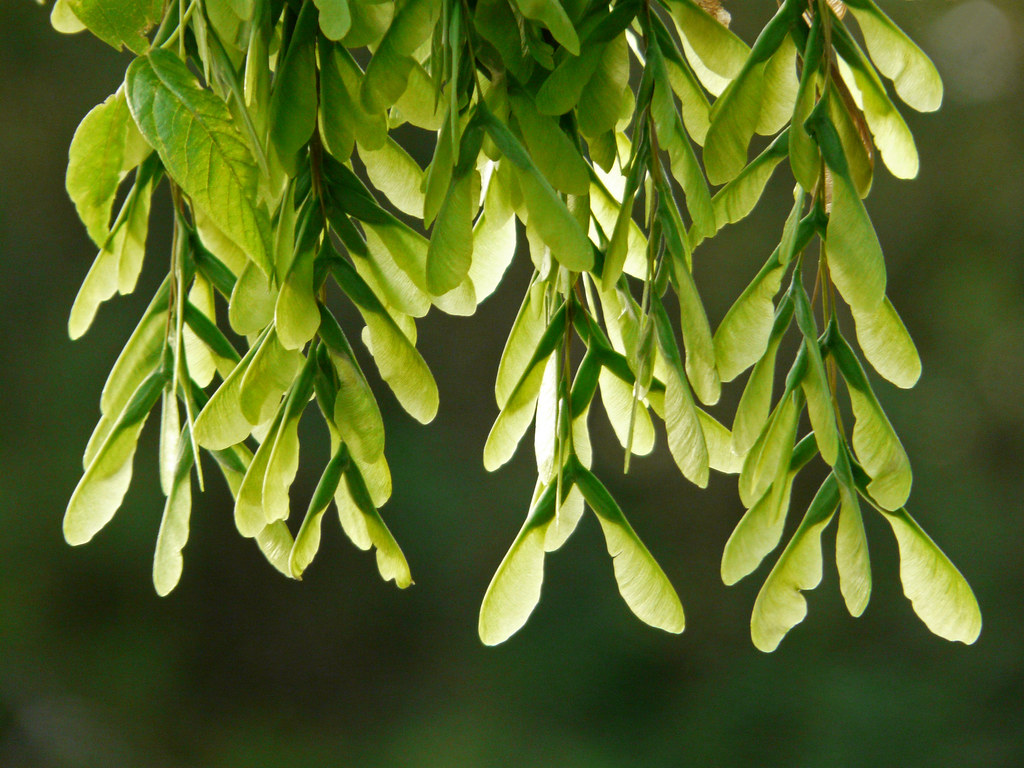
Only the female trees make the "helicopter" fruits common to maples (technically known as samaras, also called keys), and only if there is a male nearby. 
In winter, they're easy to recognize by their chubby, opposite buds; the twigs are fresh looking, green or purple, and covered with a fine fuzz that's easy to rub off.
The wood is abnormally soft for a Maple, and branches tend to break off easily, making this a somewhat scraggly tree.
Range:
The most widespread maple in the world, stretching from Ontario south to Guatemala, with a native range that covers a wide swath of North America.  In many parts of the US, especially eastern states,  it's considered a pesky tree at best; in Australia it's officially considered an invasive species.
What's in a Name?  
Acer means "sharp", in reference to the normally hard wood of maples, which the Romans used for spear shafts.  Negundo is a Sanskrit word referencing the resemblance to Chastetree (Vitex negundo).  The name Boxelder (or Box Elder) comes from the leaves' similarity to Sambucus (Elder) and the white wood's likeness to Boxwood (Buxus sempervirens).  A few sources say it's named for the fact that people make boxes from its soft wood, but I'm not buying it.  
This is also commonly known as Manitoba or Ash-leaf Maple.  In Spanish it's Fresno de Guajuco.   
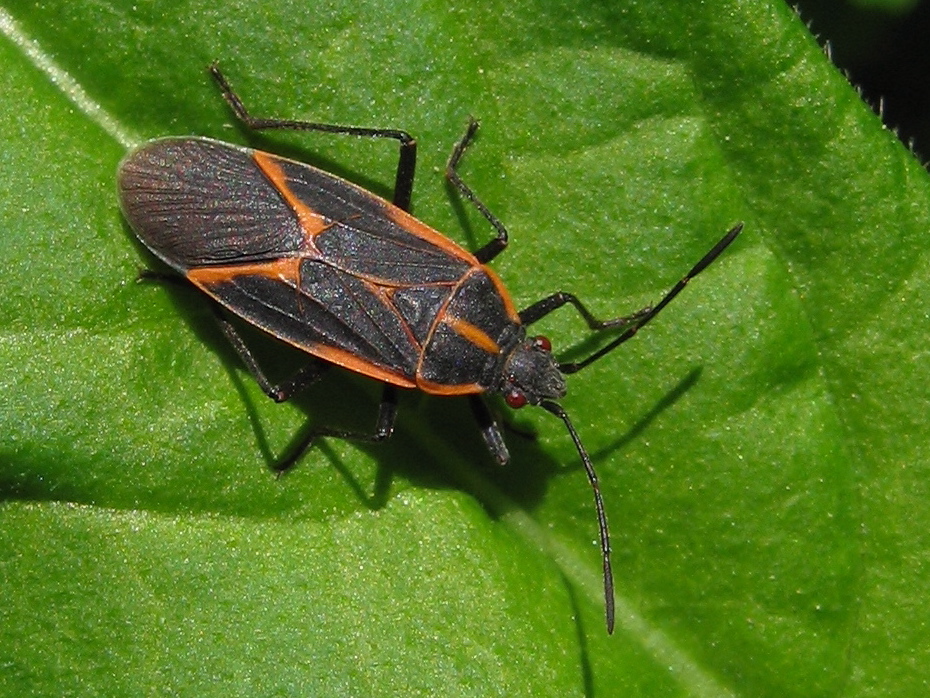
Tidbits:  Acer negundo is most famous for its relationship to the Boxelder bug (Boisea trivitattus).  There are many myths and misconceptions floating around about these little critters, so let's break it down.
1.  Boxelder bugs are found on all kinds of maple and ash trees, but greatly prefer Acer negundo.  Only the female trees are hosts to the bugs.  They feed on low vegetation in spring, lay eggs all over the tree in mid-July, and start to move toward overwintering sites in fall.
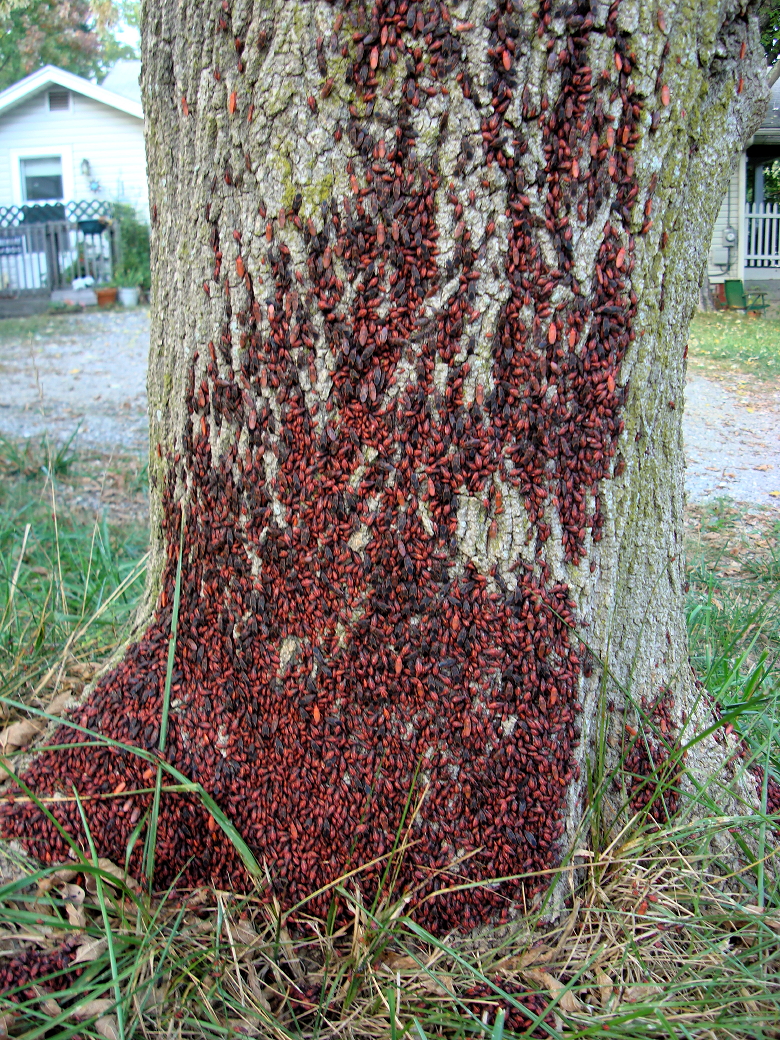
2.  These overwintering sites may very well be your warm, cozy house!  Some buildings are more susceptible to the invasion- namely, the sunniest ones (tall, good southern exposure).  Adults can travel up to two miles in search of a winter home, so chopping down the Boxelder tree in the front yard might not save you (although it may help).
3.  They don't bite.
4.  They don't cause any noticeable injury to their host trees.
5.  It's highly unlikely they'll gobble up your house plants.
6.  They might leave streaks of poo on your walls and curtains.  This is probably their greatest fault.
7.  The best defense is offense.  For a great reference on what you can do to seal up your home, see this U-MN Extension publication.
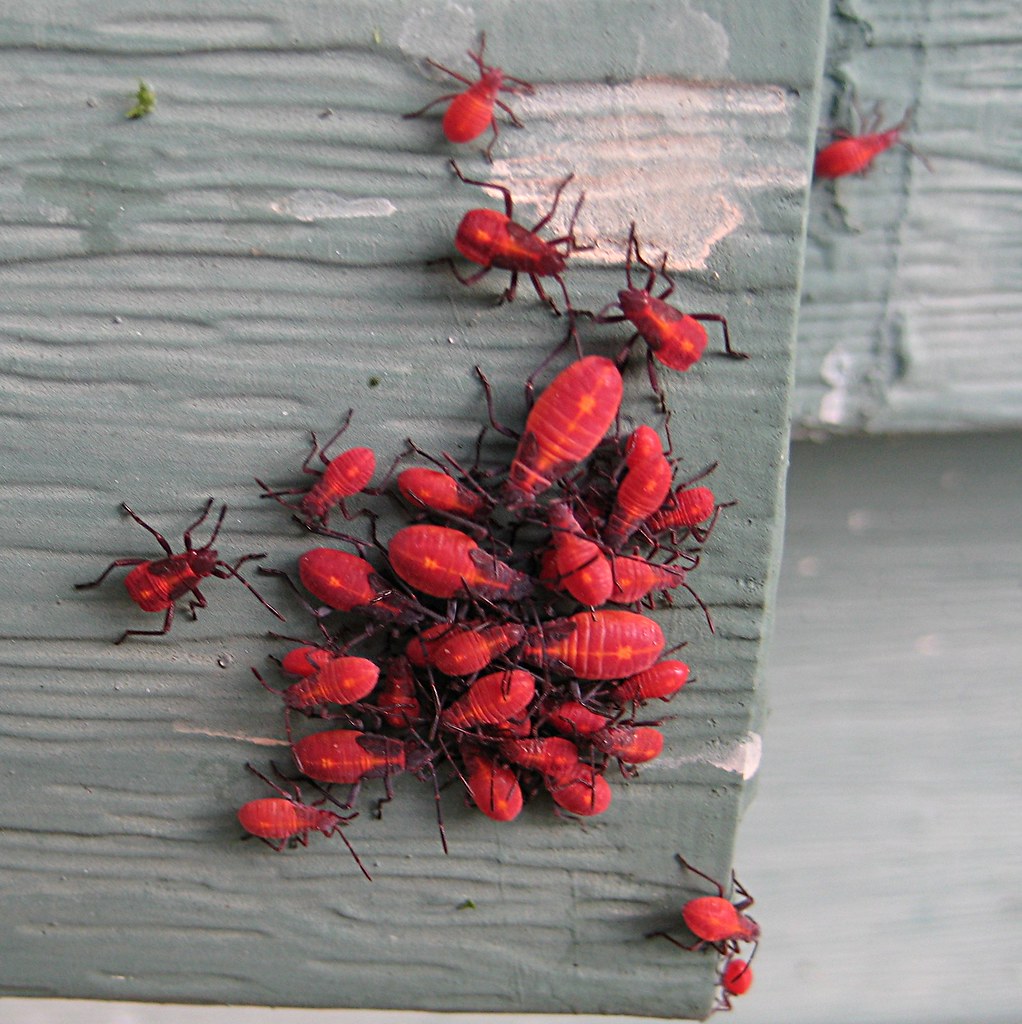
8.  You can find piles of the bright red nymphs throughout the summer.  They're harmless, fascinating insects to observe.
Boxelder is highly sensitive to 2,4-D (a common herbicide), and is susceptible to fire and mechanical damage due to its thin bark.
The wood is used for fiberboard, cheap furniture, pulp and fuel.  You can tap these trees in spring to produce maple syrup.
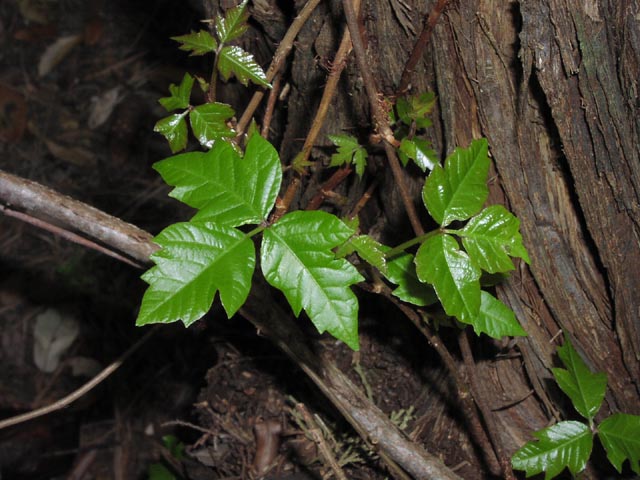
Seedlings and young saplings look a lot like Poison Ivy (Toxicodendron radicans).  The top photo here is a boxelder.  Notice the bottom poison ivy has really shiny leaves.  Not a perfect identifying feature, but a decent starting point.


Wild gardening:
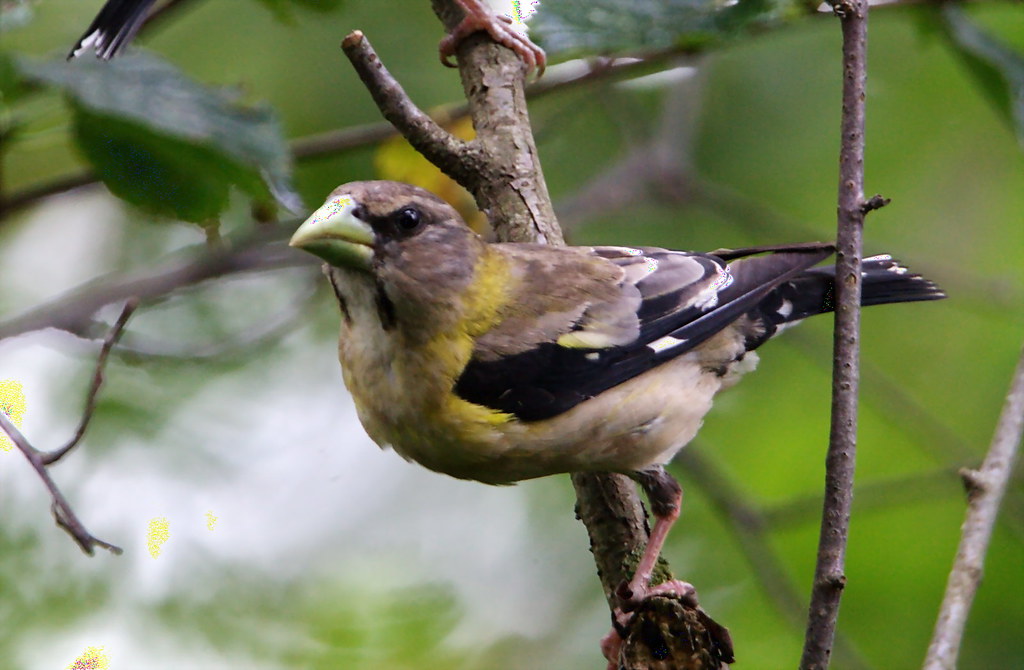
This is a fast growing, short-lived tree (avg. 60 yrs) that's hardy to Zone 2 and highly drought tolerant.  With it's prolific seeds and ready establishment, it has a tendency to become weedy or invasive.  It also suckers like crazy where branches have been cut or broken.  Maybe not the best choice for a tidy lawn, but fine for naturalized areas in the west.  In fact, it provides essential habitat factors for backyard wildlife.  Besides Boxelder bugs, it's a larval host to Cecropia Silkmoths (Hyalophora cecropia-mostly found in the east).  It's wind-pollinated but also visited by bees.  Squirrels and many birds, particularly the Evening Grosbeak (Coccothraustus vespertinus), feed on the seeds.